Expertise provided by Ivan Kavunik, Owner
If you picture addiction group as a circle of folding chairs and a lecture about damage you already know too well, you are not alone, and that is exactly the picture our team at Resilience Recovery Center set out to replace. You already know what drinking or using has cost you, and you do not need three hours a night of someone reminding you. What you may be looking for in group therapy for addiction in Fair Lawn is different: skills you can practice tomorrow, a room where people are treated with respect, and a schedule designed to work around the job you have been working hard to protect.
Maybe you are reading this for someone else. You might be a spouse or a parent who has been covering, calling in sick for them, and holding the house together while they keep functioning on the outside. That is exhausting, and this page is for you too.
This page walks through how the psychoeducation program at Resilience Recovery Center works, session by session. It covers what you learn, when groups meet, what happens if a ride falls through or a shift runs late, and how mental health and medication questions fit in without anyone sorting you into a box. Resilience Recovery Center accepts Aetna, Blue Cross Blue Shield, Cigna, and UnitedHealthcare. The admissions team can check your benefits before your first group, so insurance does not have to stay a question mark while you decide.
What Is Psychoeducation in Group Therapy for Addiction in Fair Lawn, NJ?
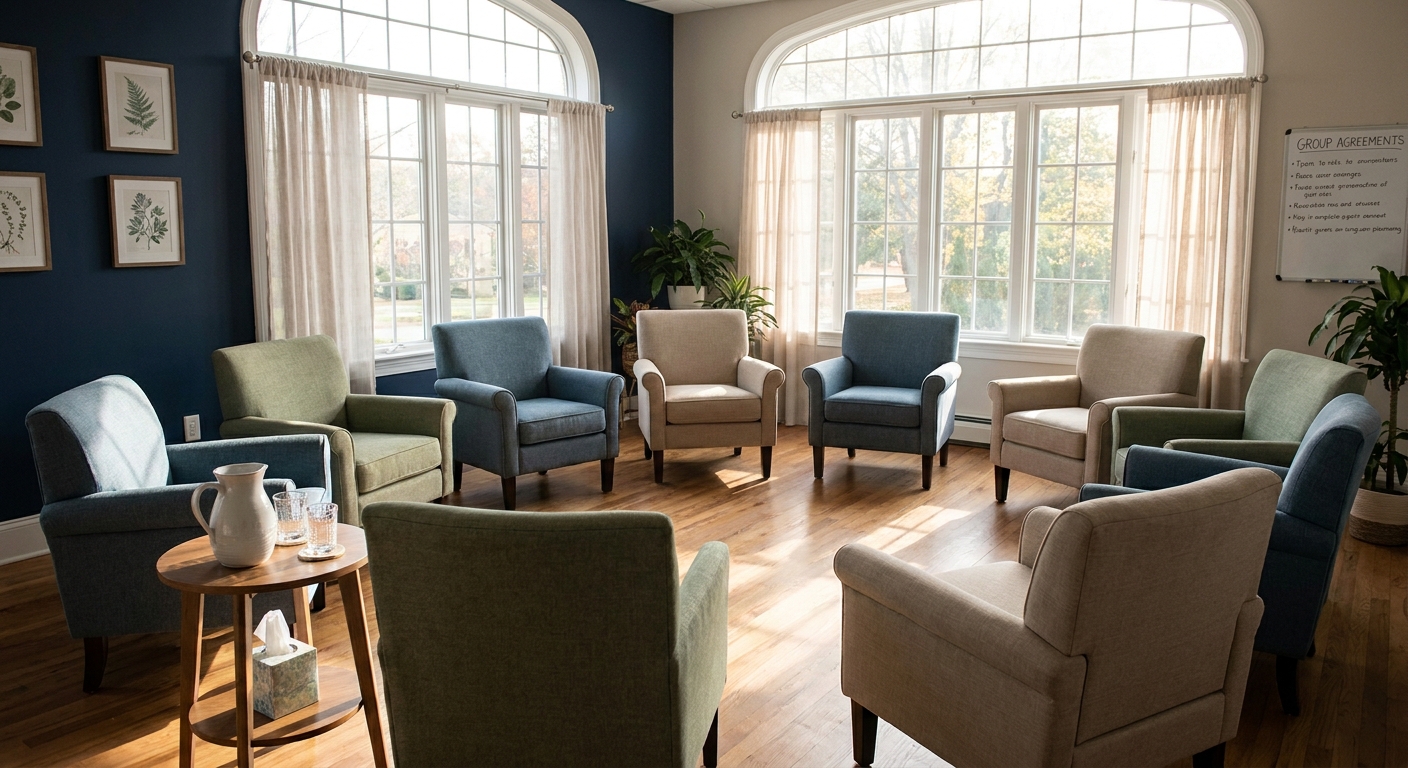
Psychoeducation is the teaching half of group therapy. In a clinician-led session, you learn how addiction, cravings, and recovery work, and then you practice skills for managing them. Process group is the sharing half, where a therapist helps the group talk through real experiences. Resilience Recovery Center runs both in the same treatment day.
Think of it like a sports team. In one room, you learn the rules and the playbook. In the next, you scrimmage. Knowing a play on a whiteboard is not the same as running it when the pressure is real. You might understand, on paper, why payday is a trigger for you. That does not mean you know what to do when the deposit hits your account and the old routine starts calling. The psychoeducation room offers the play, and the process room is where you practice it, with peers and a therapist there to give honest feedback. Resilience Recovery Center builds both into each treatment day because the team believes knowledge alone is not enough.
This pairing reflects how group care is described in federal guidance. SAMHSA’s Treatment Improvement Protocol on group therapy (TIP 41) describes psychoeducational groups as one of several common group models in substance use treatment, along with skills development, cognitive behavioral, support, and interpersonal process groups. A teaching group on its own is a starting point. Resilience Recovery Center pairs it with process work so what you learn has somewhere to go.
The bigger shift came from watching what did not work. Resilience Recovery Center moved away from having clients sit and listen to lectures. Many people in early recovery already understand that substance use has affected their lives, and repeating those consequences may not help. So the team rebuilt groups around participation: role-playing real life situations, recovery-based games, creative expression, nutrition education, and neuroscience. A role-play might be as practical as rehearsing what you say when a coworker offers you a drink after a long week.
As Ivan Kavunik, Owner, puts it: “We recognized that many individuals in early recovery already understand that substance use has negatively impacted their lives, and constantly reminding them of those consequences doesn’t necessarily create meaningful change. Instead, we started focusing on making our groups more interactive, engaging, and relevant to everyday life.”
The guiding belief is simple: recovery should not feel like a punishment. If you are spending several hours a day in treatment, that time should be meaningful, and ideally something you look forward to. This is a judgement free zone, where people are treated with respect rather than talked down to.
A typical session at Resilience Recovery Center uses worksheets, skill-building exercises, and real world recovery planning. You leave with something concrete, another tool for your tool belt, that you can try outside the building that same night.
What Does the Rotating Curriculum Cover, and Can I Start Any Week?
Yes, you can start any week. The psychoeducation curriculum at Resilience Recovery Center runs on a structured rotating schedule. Topics cycle through in order, so every client is offered the full set no matter which day they walk in.
Picture a bus loop. You can board at any stop and still ride the whole route. If your first week at Resilience Recovery Center covers the stages of change, the session on the brain’s reward system comes back around in a later week, so starting on a Wednesday does not mean falling behind. The same design helps when life gets in the way, because a topic you miss returns in the next cycle instead of disappearing.
The curriculum goes well beyond relapse talk. At Resilience Recovery Center, the rotation covers four broad areas:
- Your brain and body: the neurobiology of addiction, the brain’s reward system and cravings, post-acute withdrawal syndrome, sleep hygiene, and exercise.
- Your thinking and behavior: the stages of change, trigger identification, craving management, emotional regulation, CBT principles, DBT skills, and mindfulness.
- Your relationships: family systems, codependency, healthy boundaries, and family education.
- Your life outside treatment: financial literacy and money management, vocational readiness with mock interview prep, community reintegration, and aftercare planning.
Some of these topics do more than inform. Take post-acute withdrawal syndrome. Weeks into sobriety, sleep, mood, and focus can still feel off, and without context that can feel like failure. With context, a person may be better able to recognize the pattern and plan around it. Resilience Recovery Center teaches the brain science for this reason: understanding why cravings happen may help some people feel less shame and gives them practical ways to approach triggers.
The skills side rests on well-studied methods. The National Institute on Drug Abuse explains that behavioral therapies help people change their attitudes and behaviors related to drug use, build healthy life skills, and stay with other forms of treatment, such as medication. CBT and DBT skills are taught that way here at Resilience Recovery Center, as things to practice rather than facts to memorize.
Resilience Recovery Center also runs a weekly nutrition group as part of the rotation. It looks at how eating, sleep, and movement connect to the way your brain and body recover. The financial literacy and mock interview sessions exist because money stress and job stress are two of the hardest real world stressors in early recovery, and the program’s vocational support is designed to help people work toward getting back on their feet at work.
If you are a spouse or parent, pay close attention to the family systems, codependency, and boundaries sessions. They speak directly to what may have been happening at home: covering for someone, making excuses to their boss, carrying everything alone. Resilience Recovery Center includes family education in the curriculum and holds family sessions when clinically appropriate.
How Do Evening and Morning Group Tracks Fit Around a Job in Fair Lawn, NJ?
Groups at Resilience Recovery Center run Monday through Friday in two tracks: evenings from 6:00 PM to 9:00 PM and mornings from 9:00 AM to 12:00 PM. The 5-day IOP is 15 hours a week, the 3-day step-down is 9 hours a week, and outpatient is one group day a week.
The Resilience Recovery Center evening track is designed around a standard workday. You finish your shift, travel to Fair Lawn, and can plan to be home at a reasonable hour. The morning track serves people who work second shift, overnights, or schedules that open up before noon. Both tracks follow the same rotating curriculum, so choosing one over the other does not change what is taught. You can read more about the structure of the intensive outpatient program on its own page.
| Level of care | Group days per week | Weekly group hours |
|---|---|---|
| 5-day IOP | 5 | 15 |
| 3-day IOP step-down | 3 | 9 |
| 1-day OP | 1 | One group day, plus individual care as planned |
You do not have to guess which level fits. At Resilience Recovery Center, placement follows an admissions assessment, a drug screen, and a biopsychosocial assessment that uses the ASAM Criteria, the multidimensional placement standard addiction clinicians use nationwide. That process informs both your level of care and your track. Clinical oversight comes from a clinical director with over 20 years of experience in behavioral health and addiction treatment, and a Medical Director provides medical oversight. Executive leadership also includes people with lived recovery experience, which informs how the program approaches the people in it.
Groups are only part of the week. Resilience Recovery Center schedules individual therapy, psychiatric visits, medication management, and wrap around case management around your job. Telehealth is available for some services when clinically appropriate and allowed by your insurance. For many working adults, this flexibility matters: treatment is designed to fit into the life you already have, without requiring you to step away from it.
One limit matters here. Resilience Recovery Center does not provide detox, inpatient treatment, or residential care. If you drink heavily every day, or you use opioids and worry about withdrawal, talk to a doctor or a medical detox program before you stop. Once you are medically stable, a call to the center can help you sort out whether partial hospitalization (PHP), IOP, or outpatient care may be the right next step.
Getting to group matters too. Resilience Recovery Center coordinates transportation case by case for clients in Fair Lawn and many surrounding communities, based on your location, clinical needs, and schedule rather than a fixed mileage radius. On the insurance side, the center accepts Aetna, Blue Cross Blue Shield, Cigna, and UnitedHealthcare. Under federal parity rules, health plans that offer mental health and substance use disorder benefits generally cannot apply more restrictive financial requirements or treatment limits than they apply to medical and surgical care. Plans still differ in the details, which is why verification is part of the first call.
How Does Group Handle Mental Health Conditions and Medication Questions?
You will not be pulled into a separate group because of a diagnosis. Every IOP client at Resilience Recovery Center attends the same weekly rotation, which includes a Wednesday group called Managing Mental Health & Recovery. Facilitators tailor discussion and homework to each person’s co-occurring condition.
Anxiety, depression, and trauma often travel with substance use, and Resilience Recovery Center addresses co-occurring disorders inside one plan instead of splitting them into separate programs. Managing Mental Health & Recovery is a trauma-informed CBT group that meets once a week as part of the 15-hour IOP curriculum. It focuses on stabilization, not trauma processing. In plain terms, nobody is asked to retell the worst thing that ever happened to them in front of a room. The work is about building steadiness: noticing what sets you off, calming your body when it does, and building routines that may help.
The homework at Resilience Recovery Center is personal. A person with PTSD might work on grounding and emotional regulation with the 5-4-3-2-1 technique, which means naming five things you can see, four you can touch, three you can hear, two you can smell, and one you can taste. That person might also keep a grounding log. A person with bipolar disorder might focus on mood changes, sleep routines, and taking medication consistently, tracked in a daily mood and sleep log. It is the same room and the same session, with different assignments. When someone needs specialized trauma therapy such as EMDR, Resilience Recovery Center refers them for individual treatment when clinically appropriate, because EMDR is not a core service here.
Medication questions get the same plain treatment. Education on MAT is built into the Resilience Recovery Center rotation, covering buprenorphine, Sublocade (the monthly buprenorphine injection some people call the Suboxone shot), Vivitrol, and naltrexone. The program’s doctor leads medication education groups, and the psychiatric provider explains how these medications may reduce cravings and support stability for some people. The message stays consistent: medication can be one part of recovery, but it does not replace therapy, skill-building, or personal accountability. A Medical Director oversees psychiatric care and MAT coordination, and the team works to schedule medication check-ins around your work hours so care has fewer gaps.
Here is one person’s experience, shared without identifying details. A client working full time on buprenorphine attended evening IOP at Resilience Recovery Center, coordinated medication management with the psychiatric provider, got help from case management with probation requirements, and worked on employment and housing goals while continuing to work.
What Happens If I Miss a Session or Need Time Off Work?
A missed session does not end your treatment at Resilience Recovery Center. Contact the admissions or transportation team right away. Staff will try to arrange another pickup or help you reschedule or make up the session, and the rotating curriculum means missed topics come back around.
It may feel like one missed night proves you cannot do this, but it does not. Rides fall through, shifts run over, and kids wake up sick, so Resilience Recovery Center plans for those things. If a ride does not show, staff work on an alternate pickup. If you start a new job during treatment, the center offers transportation to and from work for the first two weeks, which covers the stretch when a new schedule can be hardest to manage.
Here is one person’s experience, shared without identifying details: a client who lost his driver’s license after a DUI kept working full time, attended evening IOP at Resilience Recovery Center, received medication management, and worked on his legal obligations, with transportation and scheduling coordinated through one care plan.
Sometimes the right answer is time away from work, and the fear is that taking it will cost the job, and then maybe the house. For employed clients who need it, the Resilience Recovery Center team completes FMLA and temporary disability paperwork. In one case, a client received 90 days off work with his job protected. Eligibility depends on the employer, how long the person has worked there, their hours, and their plan. Still, knowing the paperwork exists, and that someone will fill it out with you, may make a hard moment feel more manageable.
Then there is the fear of the room itself. Will people judge you? Do you have to talk? Psychoeducation sessions at Resilience Recovery Center focus on learning and practice, and facilitators support participation at a pace that fits you, so you do not have to share before you are ready. The same federal guide on group therapy notes that groups can reduce isolation and let people see others working through recovery. Some people find that hearing someone else describe their exact struggle is easier than describing their own, and that it can come before they feel ready to speak.
If you or your loved one tried before and it did not stick, that fear is fair too. People who feel overwhelmed at Resilience Recovery Center are reminded that treatment is temporary, and some people find that after a week or two they begin to feel more willing to continue and more engaged in their plan. Resilience Recovery Center does not publish outcome or completion statistics that have not been formally measured, and no program can promise how recovery will go. What the team can tell you is what it does: structured groups, a schedule built around your job, and coordinated support when real life gets in the way.
Questions People Ask Before Their First Group
These are the questions people raise most often before starting group therapy for addiction in Fair Lawn, answered directly.
What is psychoeducation in addiction treatment? Psychoeducation is clinician-led teaching about how addiction and recovery work. It covers cravings, triggers, brain chemistry, and coping skills. At Resilience Recovery Center, it is paired with process group in the same treatment day so you can practice and apply what you learn.
How many hours is evening IOP? Evening groups at Resilience Recovery Center run 6:00 PM to 9:00 PM, Monday through Friday. The 5-day IOP is 15 hours a week, and the 3-day step-down is 9 hours a week. Your level is informed by an admissions assessment, a drug screen, and a biopsychosocial assessment.
Can I work while in group therapy? Many working adults do. Evening and morning tracks, along with individual therapy, psychiatric visits, and case management scheduled around your job, are designed to help people keep working, depending on their needs and level of care.
Do I have to share in group? No. Psychoeducation sessions focus on learning and skill practice, and facilitators support participation at your pace, with no pressure to share before you are ready.
What if I miss a session? Call the admissions or transportation team right away. Staff help you reschedule or make up the session, and the rotating curriculum brings missed topics back around.
Can a family member make the first call? Yes. Many first calls come from a spouse or parent who sees what is happening at home. The Resilience Recovery Center admissions team can walk you through benefits, scheduling, and the assessment so you know what to expect before you talk with your loved one.
Do you offer detox or residential care? No. Resilience Recovery Center does not provide detox, inpatient, or residential treatment. If you need medical stabilization, talk to a doctor or a medical detox program first. The center can then help you decide whether PHP, IOP, or outpatient care may fit.
One Confidential Call Sets the Whole Plan in Motion
Call Resilience Recovery Center in Fair Lawn, NJ to schedule a confidential assessment and verify your Aetna, Blue Cross Blue Shield, Cigna, or UnitedHealthcare coverage. The team can then recommend a level of care and the morning or evening track that fits your work schedule. That one call is where benefits get checked, assessment times get set, and transportation needs get flagged, so you are not piecing it together alone.
One thing will make that call more useful. Have the real work schedule in front of you: start and end times, days off, any rotating shifts, and the dates that cannot move. Placement informs how much treatment is recommended, but the schedule is what the Resilience Recovery Center team builds the week around. The more specific you are, the more closely treatment can be planned around the life you are trying to protect. We are here to support you every step of the way.
Expertise and insights from
Ivan Kavunik, Owner
Find Out If Group Support Is Right for You
Sitting in a room with others and talking about addiction can feel intimidating, and it’s normal to wonder whether a psychoeducation group in Fair Lawn, NJ would really fit your life. Resilience Recovery Center can walk you through how group sessions work within the Outpatient Program and answer your questions without any pressure. Reach out to the office when you’re ready, and take that first conversation at your own pace.
Call Resilience Recovery Center
Individual experiences vary. Client stories on this page are shared without identifying details and do not predict any other person’s experience.