
How to Know Who May Be Appropriate for an Intensive Outpatient Program
You are ready to get help, but the question stopping you is whether you have to walk away from everything, your job, your home, your family routine, or whether you can pursue recovery while keeping your life intact. That question has a clinical answer. Learning who should attend an intensive outpatient program, and who may need something more intensive or something lighter, lets you stop guessing and start moving forward. Intensive outpatient treatment, often called IOP, exists for people who may benefit from structure strong enough to interrupt the pattern but flexible enough to protect the responsibilities they have been holding together. At Resilience Recovery Center in Fair Lawn, New Jersey, that decision is made through a clear clinical process, so you can call knowing what to expect instead of fearing the worst.
Who Should Attend an Intensive Outpatient Program?
You may be appropriate for an intensive outpatient program if you are medically stable, do not require 24-hour supervision or medically managed withdrawal, and have a substance use disorder or co-occurring mental health condition that may benefit from structured treatment while you continue living in the community. That is the short answer. The longer one is more honest about how the decision gets made.
At Resilience Recovery Center in Fair Lawn, NJ, IOP placement is never a guess. It rests on a comprehensive biopsychosocial assessment and placement under the American Society of Addiction Medicine (ASAM) Criteria, the standard clinicians use to match a person to the right level of care. The assessment looks at your history with substances, your mental health, your medical status, your living situation, and the real world stressors around you. It asks a practical question: can you participate safely and have an opportunity to benefit from treatment while you sleep in your own bed and go to work in the morning? If the answer appears to be yes, IOP may be an appropriate fit. This middle ground works when you need more than an hour of therapy once a week but your body is stable enough that you do not need someone watching you around the clock.
As Ivan Kavunik, Ivan Kavunik, puts it: “IOP eligibility is based on a comprehensive biopsychosocial assessment and ASAM Criteria placement. Clients must be medically stable, not require 24-hour medical supervision or medically managed withdrawal, and be able to safely participate in outpatient treatment.”¹
The person who tends to be considered for IOP is functioning on the outside but coming apart underneath. Still employed. Still parenting. Still paying the mortgage. But the drinking or the substance use has become the thing organizing the day. Every treatment plan here is overseen by Clinical Director Tammy Nussbaum, LCADC, CCS, who brings roughly 20 years of clinical experience to that judgment. This is a judgment free zone, and the goal of the assessment is not to disqualify you. It is to make an effort to match you to the level of care that may help support your recovery.
When Might You Need a Higher Level of Care First?
You may need a higher level of care first if you have no sober time yet or are not stable enough to be safe in the community without round-the-clock medical support, such as a hospital or detox setting. In those situations, the clinical team may refer you to medically managed withdrawal, commonly called detox, before you begin outpatient programming. This is not a door closing. It is a decision that aims to set you up for a safer start.
Here is why the order matters. Outpatient treatment asks you to show up, stay present in group, and manage cravings between sessions while life keeps happening around you. If your body is still managing acute withdrawal symptoms, or if the substance use has reached a point where stopping without medical supervision could be dangerous, IOP may not be able to provide the safety you need. Pushing someone into outpatient care too early can increase the risk of relapse. Resilience Recovery Center does not provide detox, inpatient, or residential treatment, so when your situation may call for that first step, the team connects you with a trusted medical detox partner and stays in the picture, ready to consider you for IOP admission when you are stable enough to participate.
Think of it as a softer landing rather than a rejection. You stabilize where it may be safer to stabilize, then you step into structured support with a body and mind ready to do the work. When you finish that first phase, admission into IOP may be coordinated so there is no gap where you fall through the cracks. That continuity is part of the approach to whole-person care: the level of care may rise and fall to match where you actually are, and we are here to support you every step of the way.
How Does the Schedule Accommodate Your Job and Daily Responsibilities?
The schedule is built around your life, not the other way around. Treatment runs 15 hours per week, delivered Monday through Friday at three hours per day, in either a morning track from 9:00 AM to 12:00 PM or an evening track from 6:00 PM to 9:00 PM. You attend before your shift or after it. You do not have to quit it.
That structure exists on purpose. Most working adults who need help are concerned that treatment means walking into a facility and losing everything they have been fighting to protect: the paycheck, the health insurance, the custody schedule, the standing in their own family. An intensive outpatient program aims to remove that trade-off, because you continue to sleep at home, show up for your family, and keep your job while receiving the clinical hours needed to break the cycle. Individual counseling, psychiatric appointments, medication management, and case management are all coordinated around your schedule, and telehealth is available when it is clinically appropriate, so a work trip or a school pickup does not derail your recovery efforts.
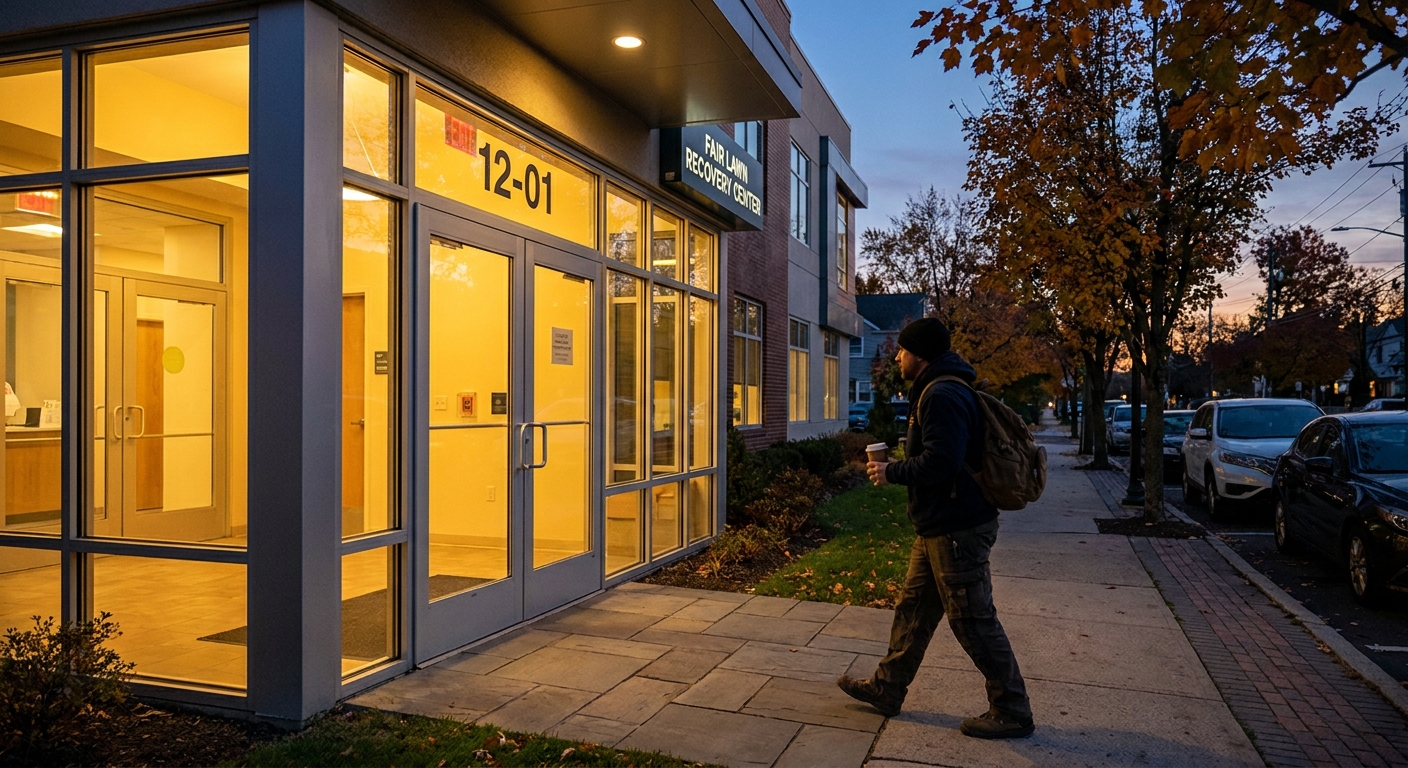
Fair Lawn, NJ residents access this treatment at 17-17 River Road, a location built for Bergen County work schedules and daily commutes. You can drop the kids at school, put in a full day, and still make an evening group. Or you can handle group in the morning and be at your desk by early afternoon. Recovery does not require stepping away from the responsibilities that give your life shape. It involves developing new tools to carry those responsibilities without the substance running the show.
What Happens From Your First Phone Call to Admission?
From your first phone call, an admissions team member completes a confidential pre-screening, gathers your basic information, reviews your substance use and mental health history, and answers your questions without judgment. The whole call is protected. Then the team verifies your insurance benefits and explains, in plain terms, what your coverage looks like and what any out-of-pocket cost would be before you commit to anything.
The next steps move quickly on purpose, because the window when someone is ready to accept help is often narrow. The team performs a benefits verification for New Jersey plans including Aetna, Cigna, BCBS, and UHC, obtains any prior authorizations your plan requires, and schedules a comprehensive clinical assessment. That assessment includes the admissions interview, a drug screen, and the biopsychosocial evaluation, and it is typically completed the same day in about three hours. If IOP appears to be an appropriate level of care, you complete intake paperwork, receive an individualized treatment plan, meet your primary counselor, and begin group programming in the next available morning or evening track. Same-day admission is possible in some circumstances, and many people are admitted within 24 to 48 hours of that first call, in some cases within an hour.
Your privacy is not a courtesy, it is a legal standard the program is built around. Every part of the intake operates in compliance with HIPAA and the federal 42 CFR Part 2 confidentiality rules. Your employer does not get a phone call. Your business stays your business. The facility operates under state licensure and DMHAS approval for ASAM Level 2.1 intensive outpatient treatment, which means the clinical framework here is built to recognized standards, not improvised.
How Might You Progress Through IOP and Step Down to Lower Levels of Care?
You may progress through IOP by stepping down in intensity as your stability grows, moving in roughly 30-day intervals from five days and 15 hours per week, to three days and nine hours, to one day and three hours of outpatient support. The step-down is earned, not automatic, and it is guided by ongoing clinical assessment rather than a fixed calendar.
The indicators the clinical team watches are concrete. Consistent attendance shows you can hold the structure. Negative drug screens suggest the recovery is taking hold in your body, not just in your intentions. Progress on your treatment plan goals, steadier mood, easing cravings, and stronger coping when real world stressors hit may all signal that you are ready for less intensive support. When those markers line up, you may move to a lighter schedule that gives you more room to rebuild while keeping a clinical safety net underneath you. If they do not line up yet, you stay where you are, and that is not a failure. It is the plan adjusting to you.
This gradual approach matters because the drop-off from intensive treatment straight back into unstructured life is where some people stumble. Stepping down in stages lets you practice recovery under real conditions with support that thins out only as you demonstrate you can carry more on your own. By the time you reach one day a week, you have spent months building the skills. The goal is sustainable recovery, a life that holds together after the program ends, not a finish line you cross and forget.
What Clinical Services Are Included in IOP?
An intensive outpatient program here includes far more than a weekly talk. You receive individual therapy, group therapy built on evidence-based modalities, medication-assisted treatment coordination when appropriate, care from therapists who can address co-occurring mental health conditions, and case management that connects your recovery to the practical parts of your life. It is an approach to whole-person care rather than counseling in isolation.
The group and individual work draws on cognitive behavioral therapy (CBT), trauma-informed care, and motivational interviewing, approaches with a real research base behind them, adapted to where you are rather than delivered as a one-size-fits-all script. For patients taking buprenorphine or naltrexone, the team coordinates medication-assisted treatment (MAT), keeping the psychiatry and behavioral health sides aligned so nothing falls between providers. Many people arrive carrying both a substance use disorder and a mental health condition like depression, anxiety, or PTSD, and the dual-licensed therapists on staff are equipped to address both together rather than sending you somewhere else for half of it. Validated screening tools such as the PHQ-9 and GAD-7 help track that progress over time.
Case management is where this program seeks to distinguish itself from counseling-only options. Recovery does not happen in a vacuum, and neither should treatment. Case managers help connect you to housing, employment support, and community resources, addressing the pressures that so often pull people back toward substances. Every one of these services is coordinated under one roof and overseen by Clinical Director Tammy Nussbaum, LCADC, CCS, whose roughly two decades of experience anchor the clinical approach behind each treatment plan. The aim is straightforward: offer you the structure to stabilize and the tools to support stability long after you walk out the door.
Frequently Asked Questions
Who may be appropriate for an intensive outpatient program?
You may be appropriate for an intensive outpatient program if you are medically stable, do not require 24-hour supervision, can participate safely while living at home, and have a substance use disorder or co-occurring mental health condition that may benefit from structured treatment. A biopsychosocial assessment and ASAM Criteria placement help determine whether IOP may be an appropriate level of care for you.
Can I work while attending intensive outpatient treatment?
Yes, the IOP schedule is designed for working adults. You choose a morning track from 9:00 AM to noon or an evening track from 6:00 PM to 9:00 PM, so you attend before or after your shift. Individual counseling, medication management, and case management are coordinated around your work and family commitments, with telehealth available when clinically appropriate.
How long might intensive outpatient treatment last?
The length is individualized rather than fixed. Many participants step down in roughly 30-day intervals, moving from 15 hours per week to nine hours to three hours as their stability improves. Attendance, negative drug screens, and progress on treatment goals guide each transition, so the timeline reflects your readiness, not a set number of weeks.
What if I may not be stable enough for outpatient treatment yet?
If you have no sober time yet or are not medically stable, the clinical team may refer you to a higher level of care, such as medically managed withdrawal, first. This is not a rejection. It aims to help you enter IOP when you can participate safely and have an opportunity to benefit, and the team may coordinate your admission once you are ready.
Does insurance cover intensive outpatient programs in New Jersey?
Many New Jersey insurance plans, including Aetna, Cigna, BCBS, and UHC, cover intensive outpatient treatment. The admissions team verifies your specific benefits, explains your expected coverage and any out-of-pocket cost, and handles required prior authorizations before you begin, so there are no financial surprises after you start.
How quickly can I start intensive outpatient treatment?
Same-day admission is sometimes possible. Many people are admitted within 24 to 48 hours of their first phone call, and in some cases within an hour. The pre-screening, insurance verification, and comprehensive clinical assessment are typically completed the same day, taking about three hours in total.
Take the Next Step
You do not have to keep guessing whether IOP may be appropriate for you or whether you will be told you have to give up everything to pursue wellness. Call Resilience Recovery Center at the number on this page to complete a confidential pre-screening, verify your insurance benefits, and schedule a clinical assessment, often with same-day admission available in some circumstances. One phone call tells you where you stand and what your next step looks like, and here is the part worth holding onto: learning who may be appropriate for an intensive outpatient program is not something you have to figure out alone at your kitchen table. That is what the assessment is for, and you will not walk any of it alone.
Expertise and insights from
- Ivan Kavunik, Ivan Kavunik
Find Out If IOP Is Right for Your Recovery
If you’re weighing whether an intensive outpatient program fits your schedule and recovery needs, a conversation can bring clarity. Our team at Resilience Recovery Center in Fair Lawn, NJ understands that choosing the right level of care is a personal decision, and we’re here to walk through your options with you.
Call Resilience Recovery Center
Individual responses to treatment vary, and no program can guarantee specific outcomes or recovery timelines for any individual.