The Surprising Benefits of IOP vs Inpatient Rehab You Should Know
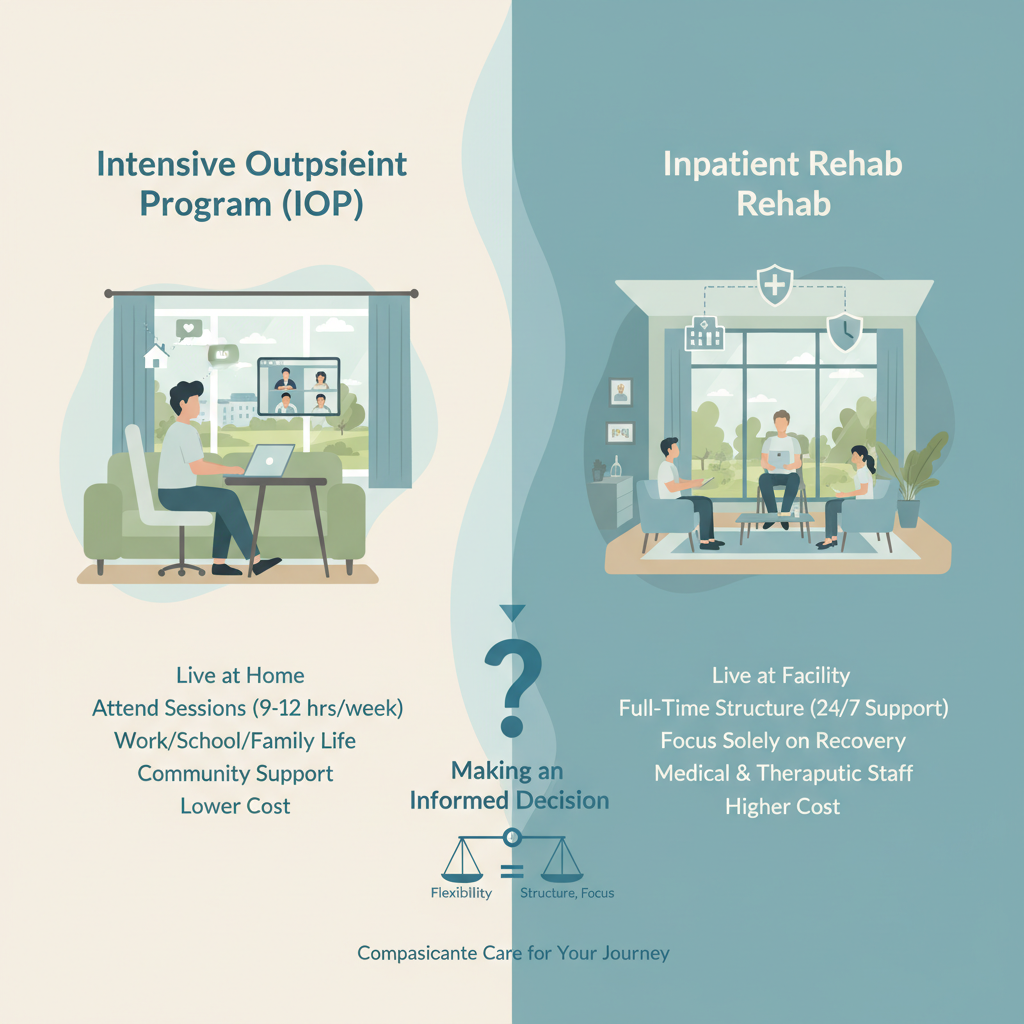
A client sat in our Fair Lawn office after completing detox and asked the question families ask every day: “If I go to residential treatment, will I still have a job when I get out?” That single fear sits underneath almost every honest conversation about iop vs inpatient rehab. The assumption is that real treatment means disappearing for thirty days, and that disappearing costs you the paycheck, the health insurance, the custody arrangement, and the housing you have been holding together with both hands. For many working adults who are medically stable, intensive outpatient treatment can offer the same clinical care as a residential program while you keep the structure that may support your recovery once treatment ends.
How IOP Delivers the Same Clinical Treatment as Inpatient Rehab, Without Making You Leave Home
For a medically stable adult, an intensive outpatient program provides the same evidence-based addiction treatment services used in residential care, delivered around your life instead of in place of it. The difference is not the quality of the treatment. It is the 24-hour supervision, which not everyone clinically needs.
At Resilience Recovery Center in Fair Lawn, our IOP runs Monday through Friday on two tracks: a morning track from 9 a.m. to 12 p.m. and an evening track from 6 p.m. to 9 p.m. That structure adds up to roughly 15 hours of treatment each week, with about three hours of structured group therapy on each treatment day. Groups focus on relapse prevention, cognitive behavioral therapy (CBT), dialectical behavior therapy (DBT), trauma-informed care, emotional regulation, and neuroscience-informed psychoeducation, so you understand what cravings are actually doing in your brain. On top of group work, you meet weekly for individual counseling to address what does not belong in a room full of peers.
Medication management and psychiatric evaluations are overseen by our Medical Director, Dr. Wayne Lajewski, a licensed physician who assesses psychiatric and medical needs, manages medication, and oversees Medication-Assisted Treatment (MAT) coordination, including buprenorphine-based options such as Suboxone and the Sublocade injection when clinically indicated. Our clinical program is led by a Clinical Director who holds LCADC and CCS credentials. The team reviews your progress in regular multidisciplinary meetings and adjusts your plan in real time. In our experience supervising hundreds of IOP clients, we see people who arrive believing outpatient means less serious treatment, then realize after their first week that fifteen hours of structured therapy while managing work stress and home triggers can feel harder than residential care where the only job is recovery. The point of iop vs inpatient rehab is not less care. It is care that fits a life worth protecting.
IOP vs Inpatient Rehab: How Our Team Decides Which Level of Care You Actually Need
The differences between inpatient and outpatient care are real, but the decision between them is not a preference or a price comparison. It is a clinical judgment made through a comprehensive biopsychosocial assessment, a psychiatric evaluation, a substance use assessment, and a review guided by the ASAM Criteria, the national standard for matching a person to the right intensity of care.
During that assessment, we look at the severity of substance use, current withdrawal risk, psychiatric stability, medical needs, relapse history, your recovery environment, your motivation, cognitive functioning, and whether you can participate safely in structured treatment while remaining in the community. An appropriate IOP candidate is medically stable, is not in acute withdrawal that requires medical management, does not present an imminent danger to self or others, and can engage in treatment without needing round-the-clock monitoring. When those things are true, staying connected to work and family may offer clinical advantages, not a compromise.
There are clear situations where we do not start someone in IOP, and this is a judgment free zone about that reality. If the evaluation shows active withdrawal requiring medical supervision, uncontrolled psychiatric symptoms such as active psychosis or severe mania, persistent suicidal or homicidal risk requiring higher monitoring, significant medical instability, or a repeated inability to stay safe in outpatient settings despite intensive support, we coordinate a referral to a trusted medical detox partner or a higher-acuity program first. Matching the person to the safest setting matters more than filling a seat. Many people arrive here as post-detox transition admissions after finishing detox elsewhere, and for those clients we pull discharge records, medication lists, and toxicology results so the plan we build reflects exactly where you are, not where a brochure assumes you are.
Why the Weeks Right After Detox Are the Most Dangerous, and How IOP Holds You Steady
We have watched clients leave detox on a Friday feeling strong and relapse by Tuesday once the structure disappeared and the same problems reappeared. IOP addresses that risk with structure, close monitoring, MAT coordination, and relapse prevention planning during exactly the stretch when people tend to slip.
Consider a working adult who came to us after completing medical detox for alcohol use disorder. (Details here are anonymized to protect confidentiality.) This client wanted back to work as fast as possible but had learned the hard way that going straight from detox to full shifts had triggered relapse within weeks before. Our team named that transition as the highest-risk phase and built a plan around structure and accountability rather than willpower alone. The client attended five-day-per-week IOP with daily group therapy and weekly individual counseling, met with our psychiatric provider for a post-detox medication review, and had MAT coordinated with the prescribing provider while we monitored adherence and side effects.
Over roughly six weeks, the client maintained over 90 percent attendance, produced negative drug screens throughout, returned to full-time employment, stayed engaged with psychiatric follow-up, reported cravings easing week over week, and then stepped down to a lower level of care. What appeared to make a difference was not a single group or a single medication. It was giving the person a softer landing during the window when relapse usually happens, so new coping skills had time to take hold in the real world. The continuum of care, from detox through IOP to standard outpatient programs, exists precisely because recovery is often built in stages over weeks and months, a structure detailed in SAMHSA’s clinical guidance on intensive outpatient treatment.
How Does Case Management Close the Gaps That Send People Back to Substances?
Case management aims to remove barriers to engagement. Our team coordinates FMLA and temporary disability paperwork, sober living placement, transportation, legal documentation, psychiatric appointments, and MAT compliance into one plan, so you are not left stitching disconnected systems together during early recovery.
A warehouse supervisor working Monday through Friday from 7 a.m. to 3:30 p.m. shows why this matters. He had completed detox for opioid use disorder and was concerned that treatment would cost him the job that was his only source of income and health insurance. Because he was medically stable, motivated, and had stable housing, he was clinically appropriate for IOP rather than residential care. We enrolled him in the evening track from 6 p.m. to 9 p.m., five days a week, so he never missed a shift. In his first week, our case manager coordinated FMLA certification documenting the medical necessity of treatment, scheduled medication management around his work hours, communicated with his MAT provider once releases were signed, arranged transportation when conflicts came up, and helped secure sober living placement.
Over about eight weeks, he kept his job, stayed engaged in MAT and therapy, produced negative drug screens, moved into sober living, met his legal obligations, and stepped down to a lower level of care without the work disruption that had unraveled a previous attempt. He told us it was the first time treatment felt manageable, because he no longer had to choose between keeping his paycheck and getting help. Families in Fair Lawn tell us their most exhausting problem is not knowing who is responsible for each piece of care. When one team owns the coordination, you stop carrying that alone. We are here to support you every step of the way, and that support is practical, not just clinical.
Can IOP Treat PTSD, Anxiety, and Depression Alongside Substance Use?
Yes. When you are psychiatrically stable and do not require inpatient psychiatric hospitalization, our IOP treats co-occurring disorders — mental health conditions such as anxiety disorders, depressive disorders, trauma and PTSD, OCD, and bipolar disorder that is stable with appropriate management — integrated with substance use treatment rather than handled in separate silos.
A diagnosis like PTSD does not automatically require residential care. A working adult with opioid use disorder and PTSD came to us after detox with a history of trauma, panic under stress, and several past relapses following discharge from higher levels of care. At assessment, the client was medically stable, denied acute safety concerns, had stable housing, and was motivated. Based on the psychiatric evaluation, biopsychosocial assessment, and ASAM-informed review, IOP was the appropriate level of care. The client attended five evenings a week with roughly three hours of group per session plus weekly individual therapy, met the psychiatric provider for medication management, and had MAT coordinated with the prescriber.
Therapeutically, the team integrated CBT, DBT, trauma-informed care, neuroscience-informed psychoeducation, and mindfulness-based grounding. Rather than reopening traumatic memories during a fragile period, early work built safety first: recognizing trauma triggers, understanding how trauma and substance use affect the brain and nervous system, and strengthening coping skills before advancing to deeper trauma work. Over about eight weeks the client kept steady attendance, stayed in MAT, produced negative drug screens, showed improvement in emotional regulation, leaned less on avoidance, and kept working the whole time before stepping down with ongoing psychiatric follow-up. Treating both the mental health condition and the addiction together in one coordinated plan is the standard for co-occurring disorders, and it is another set of tools on your tool belt that a fragmented system rarely delivers.
How Do We Know When You Are Ready to Step Down from IOP?
Step-down is not a calendar date or a single test result. It is a combination of objective measures and clinical judgment reviewed by the multidisciplinary team, so you move to a lower level of care because you appear steadier, not because a set number of weeks passed.
A client progressing well generally shows at least four consecutive weeks of negative alcohol and drug screens, 90 percent or greater attendance, active participation in both group and individual therapy, and consistent engagement with the individualized treatment plan. We also watch for changes in how clients talk about triggers: early on, someone might say “I saw my old dealer’s car and almost texted him,” but after several weeks that same person might say “I saw the car, noticed the urge, used the grounding technique from DBT group, and called my sponsor instead.” That shift from reactive panic to deliberate coping tells us the skills are becoming automatic, not memorized.
Beyond the measurable markers, we assess whether you can independently identify your relapse triggers, use CBT and DBT strategies before a crisis builds rather than after, stay adherent to MAT when it is prescribed, and regulate your emotions without needing intensive daily support. For a working adult, we look at whether you have returned to or maintained work without substance-related absences or disciplinary issues, whether you keep appointments, and whether housing and your recovery support system are stable. When those pieces line up, the team decides you may be ready. That is what “back on their feet” actually looks like on paper, and it is why real step-down aims to protect the progress you fought for instead of gambling it.
Frequently Asked Questions
Can I attend IOP while working full-time in Fair Lawn?
Yes. Our morning track runs 9 a.m. to 12 p.m. and our evening track runs 6 p.m. to 9 p.m., Monday through Friday, so you can align treatment with your shifts. When appropriate, our case managers also coordinate FMLA documentation with your employer so you can attend without jeopardizing your job.
How do clinical teams decide whether I need inpatient rehab or can start in IOP?
The decision comes from a comprehensive biopsychosocial assessment, a psychiatric evaluation, and an ASAM Criteria review. We weigh withdrawal risk, psychiatric stability, medical needs, relapse history, and your ability to stay safe in the community. Medically stable clients who do not need 24-hour monitoring are generally appropriate for IOP. Weighing iop vs inpatient rehab is a clinical judgment, never a guess.
What happens if I relapse during IOP treatment?
Relapse triggers a treatment team review, not automatic discharge. We adjust your plan, increase structure or monitoring where needed, and revisit your relapse prevention strategy. If your safety cannot be maintained in an outpatient setting, we coordinate a step up to a higher level of care, then support your return when you are stable.
Does IOP treat co-occurring anxiety, depression, or PTSD alongside substance use disorder?
Yes, for clients who are psychiatrically stable. We integrate CBT, DBT, trauma-informed care, and psychiatric oversight to treat mental health conditions like anxiety, depression, PTSD, and OCD alongside a substance use disorder. Clients needing inpatient psychiatric care or 24-hour monitoring are referred to the appropriate level of care first.
How long does IOP last before I step down to outpatient care?
There is no fixed timeline. Step-down depends on objective measures: four or more consecutive weeks of negative screens, 90 percent or greater attendance, active participation, sustained craving reduction, consistent use of coping skills, medication adherence, and stable housing. Many working adults step down in roughly six to eight weeks when those markers hold, though individual timelines vary.
Will my insurance cover IOP at Resilience Recovery Center in Fair Lawn?
We accept BCBS, Aetna, Cigna, and UnitedHealthcare, and many commercial plans cover intensive outpatient treatment for substance abuse when it is medically necessary. Our admissions team will run a confidential benefits verification for you so you know what your plan covers before you commit to anything.
Contact Resilience Recovery Center in Fair Lawn at [phone number] to schedule a confidential assessment and find out whether IOP is medically appropriate for your situation. One call starts the coordination, and that is the moment you stop carrying it alone.
Find Out Which Path Fits Your Life
If you’re weighing your options and wondering whether intensive outpatient programs give you the structure you need while keeping your daily life intact, you’re asking the right question. The team at Resilience Recovery Center in Fair Lawn, NJ understands that choosing between IOP and inpatient treatment feels like a major decision, because it is. A brief conversation can help clarify which level of care aligns with where you are right now and where you want to go.
Call Resilience Recovery Center
Recovery is individual and outcomes vary based on many factors including motivation, environment, co-occurring conditions, adherence to treatment, and level of support.