Understanding IOP vs outpatient addiction treatment
When you first look into iop vs outpatient addiction treatment, the terminology can feel confusing. Both options let you live at home, keep some of your regular responsibilities, and avoid a full residential stay. Yet the structure, time commitment, and level of support are very different, and those differences matter for your recovery.
At its core, the question is not which level of care is “better,” but which is the right fit for where you are right now. The right match can give you enough structure to stay accountable without disrupting your entire life, while the wrong level of care can leave you either overwhelmed or under-supported.
What intensive outpatient treatment is
An Intensive Outpatient Program, or IOP, is a structured addiction treatment program that provides multiple hours of therapy each week while allowing you to live at home and maintain parts of your daily routine.
Research defines IOPs as programs that provide at least 9 hours per week of individual, group, and family therapy, often more, while you remain in your home and community [1]. Many programs provide 20 to 30 hours of treatment per week for 30 to 90 days [2].
In practice, an IOP is often a step between inpatient rehab and standard outpatient counseling. It can also be the first point of care if you need more than weekly therapy but do not require 24-hour medical monitoring. For a deeper overview of this level of care, you can explore what an intensive outpatient program is.
What standard outpatient addiction treatment is
Outpatient addiction treatment usually refers to traditional counseling or therapy visits that happen one to three times per week for 1 to 2 hours at a time. You might attend:
- Weekly one-on-one sessions with a therapist
- One or two group therapy or education groups each week
- Occasional family or couples sessions
Standard outpatient programs typically involve less than 20 hours of treatment per week and are geared toward people with mild to moderate substance use disorders or those stepping down from a higher level of care such as IOP or residential treatment [2].
These programs rely heavily on your own accountability and support system, because you have less frequent contact with your treatment team. As one clinical resource notes, if you attend only outpatient treatment without being ready or adequately supported, you may face a higher risk of relapse compared to a more structured level like IOP [2].
How IOP treatment works day to day
Although every program is different, most intensive outpatient programs follow a consistent framework that combines structure and flexibility. Understanding how intensive outpatient treatment works can help you picture yourself in this level of care.
Typical time commitment and schedule
Most IOPs meet several days per week, often 3 to 5 days, with each session lasting 2 to 4 hours. Many programs last 6 to 12 weeks, sometimes longer depending on your needs [3].
A common schedule might look like:
- Three evenings per week, 6:00 p.m. to 9:00 p.m.
- Or four mornings per week, 9:00 a.m. to 12:00 p.m.
This design allows you to continue working, going to school, or caring for family while attending treatment. If you want a more detailed look at schedules, see the guide on the intensive outpatient program schedule for addiction and how many hours an intensive outpatient program involves.
Core therapy structure in IOP
The heart of IOP is a structured mix of therapies. According to national treatment descriptions, IOPs typically rely on group therapy as the main format, with individual and family sessions supporting your work [4].
A typical IOP therapy structure may include:
- Process groups where you discuss cravings, triggers, and current stressors
- Psychoeducational groups that teach you about addiction, relapse prevention, and coping skills
- Individual counseling focused on your specific history, mental health, and goals
- Family or couples sessions to address communication, boundaries, and support at home
- Skills groups for mindfulness, emotional regulation, or building healthy routines
You can read more about the intensive outpatient program therapy structure and what to expect session by session in a program.
What to expect emotionally and practically
Early in IOP you complete an intake assessment, set treatment goals, and receive a personalized plan. From there, your weeks follow a predictable rhythm:
- Arriving at the clinic or logging in online for scheduled sessions
- Checking in with staff about your mood, cravings, and any substance use
- Attending groups with a consistent set of peers
- Completing home practice, such as journaling or skills exercises
Many people find that the routine itself becomes a stabilizing force. You are not left to navigate your week alone. Instead, you have frequent checkpoints and accountability, which can be especially helpful in early recovery.
For a more detailed preview, you can explore how intensive outpatient treatment works and what to expect in an IOP program.
How long IOP and outpatient programs last
When you compare IOP vs outpatient addiction treatment, length of care is an important distinction.
Intensive Outpatient Programs usually run for 6 to 12 weeks, sometimes 3 to 4 months, with multiple sessions per week [3]. Some people step down to a lower intensity schedule as they progress, such as moving from four sessions per week to two.
Standard outpatient programs generally last longer but with fewer hours per week. They might continue for several months or more, often as ongoing aftercare or maintenance. National resources note that standard outpatient treatment is often less expensive per week because it involves fewer hours, but it also has less built-in structure [4].
If you want to understand the full timeline you might be committing to, see the resource on how long an IOP program lasts.
Effectiveness of IOP compared to other care
You may wonder whether IOP is “enough” care compared with inpatient or whether it offers more than standard outpatient treatment. Research can help you feel more confident about the decision.
A large body of clinical trials and quasi-experimental studies has found that intensive outpatient programs are as effective as inpatient or residential treatment for most people seeking help. Across multiple studies from 1995 to 2012, IOP participants showed substantial reductions in alcohol and drug use, with about 50 to 70 percent reporting abstinence at follow up [1]. No significant differences in outcomes were observed between IOP and inpatient settings for most participants.
Other analyses arrive at similar conclusions. Outcome studies show that IOPs can yield results comparable to inpatient rehab even though the level of intensity is lower [4]. For individuals with the most severe substance use or complex co-occurring mental health conditions, residential care may still be preferable, but these cases represent a specific subgroup [1].
This evidence has led many policymakers and health plans to recognize IOP as a critical level of care that should be covered as a standard benefit for substance use disorders [1]. If you are asking whether IOP is a legitimate alternative to inpatient for many people, the research supports that it is.
For more on outcomes and recovery trajectories, you can read about how effective intensive outpatient programs are and how IOP helps addiction recovery.
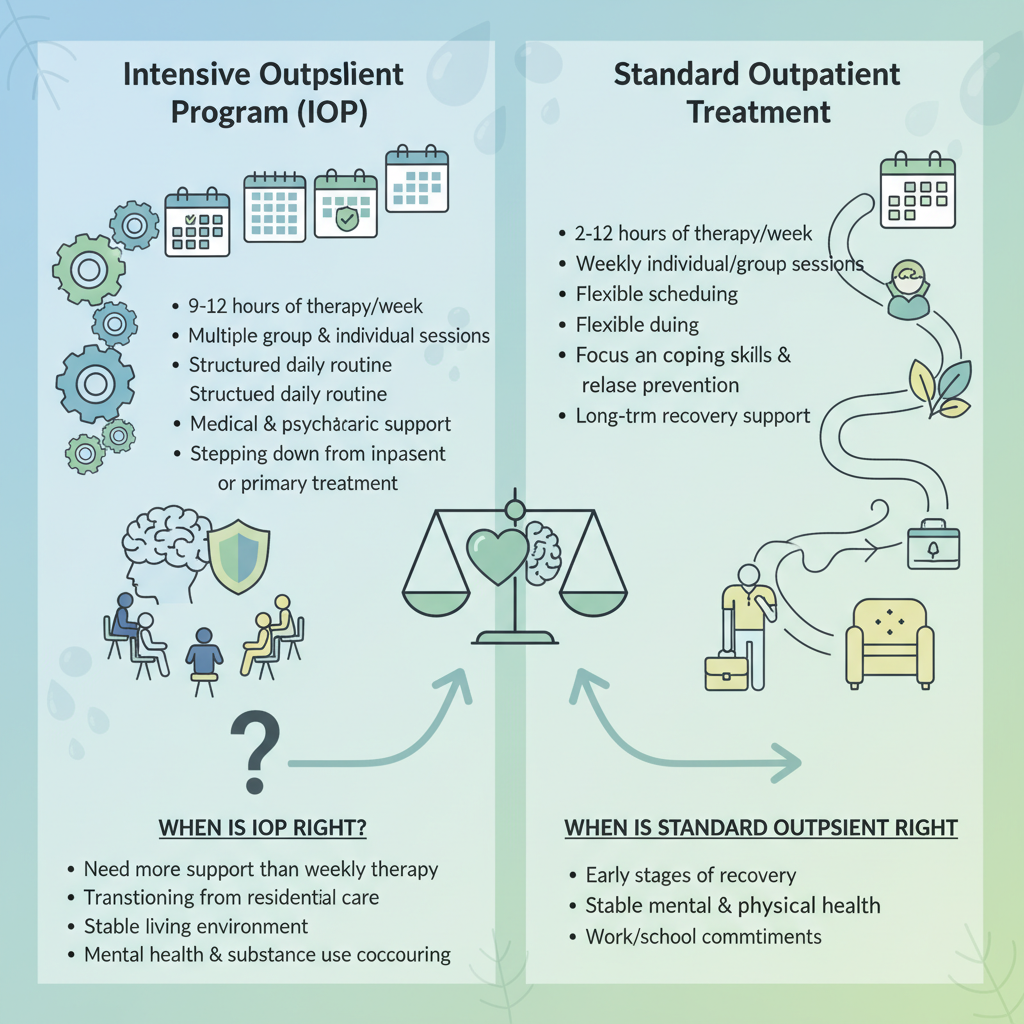
Key differences between IOP and standard outpatient care
Although both IOP and outpatient programs let you live at home, they differ in several key ways that shape your day-to-day experience.
| Aspect | Intensive Outpatient Program (IOP) | Standard Outpatient Treatment |
|---|---|---|
| Weekly hours | Usually 9 to 30 hours per week [5] | Typically under 20 hours per week [2] |
| Structure | Highly structured schedule with multiple group sessions plus individual and family therapy | Fewer, more flexible appointments, often one to three sessions per week |
| Intensity | Designed for moderate to severe addiction or as step-down from inpatient | Often for mild to moderate addiction or post-IOP aftercare [6] |
| Supervision & support | Frequent contact with staff and peers, higher accountability | Less frequent contact, greater reliance on self-management and external support [2] |
| Cost | More costly than standard outpatient but typically less than inpatient [4] | Usually the least expensive level of structured treatment per week |
| Typical role in care | Main level of treatment or step-down from residential | Entry point for milder cases or continuing care after IOP or inpatient [6] |
Seeing the differences laid out can help you decide whether you need the built-in structure of IOP or the flexibility of standard outpatient care.
When an IOP is usually the right level of care
Choosing the right level of care is about honestly assessing your current symptoms, risks, and support system. Clinical guidelines and treatment centers commonly recommend IOP when:
- Your substance use is moderate to severe, or you have had difficulty staying sober with weekly therapy alone
- You are stepping down from inpatient or residential treatment and want structured support as you transition home
- You have co-occurring mental health conditions, such as anxiety, depression, or trauma, that need coordinated treatment
- Your home environment is not fully stable or supportive, and you benefit from regular contact with professionals and peers
- You need more accountability and relapse prevention skills but cannot leave work or family for 24-hour care
Some evidence suggests that people with the most severe or medically complicated addictions may benefit more from inpatient care. However, this appears limited to the most severely impaired individuals, while most others do just as well in IOP [1].
If you are wondering whether you meet typical criteria, resources such as who qualifies for intensive outpatient treatment and who should attend an intensive outpatient program can help you think through the specifics.
When standard outpatient treatment may be enough
Standard outpatient addiction treatment may be a good fit if:
- Your substance use is mild or early and you have not experienced repeated relapses
- You have a strong, stable support system at home and in your community
- You are functioning well at work or school and your daily life is not severely disrupted by substance use
- You have already completed IOP or inpatient rehab and need a lower level of ongoing support
- You are ready to take more responsibility for managing triggers between appointments
Outpatient treatment often serves as aftercare following IOP or residential programs. Resources note that basic outpatient services may involve one or two therapy sessions or classes per week as you maintain progress and reduce relapse risk in early recovery [6].
Comparing IOP to inpatient rehab
If you are still deciding between IOP vs inpatient, it can help to look at how these two levels compare directly, separate from standard outpatient.
Inpatient or residential rehab involves 24-hour care in a live-in setting. You temporarily step away from your home environment, which can be essential if you face high medical risks, intense withdrawal, or a very unstable living situation.
IOP, in contrast:
- Lets you remain at home while attending structured treatment
- Requires fewer hours per week than inpatient, so you can keep working or parenting
- Costs significantly less than residential care in most cases [7]
- Still provides intensive therapy and relapse prevention skills
Many people move from inpatient to IOP, then to standard outpatient, as part of a “step-down” continuum of care. You can learn more in depth about this comparison in the guide on IOP vs inpatient rehab and when to choose intensive outpatient rehab.
Cost and insurance considerations
Cost is often a practical factor when you weigh iop vs outpatient addiction treatment.
- IOPs typically cost between 250 and 350 dollars per day, though actual rates vary by program and location [4]. Without insurance, monthly costs often range from 3,000 to 10,000 dollars [3].
- Standard outpatient therapy usually costs less per week because you attend fewer hours, even if the hourly rate is similar.
The good news is that in 2024 most private insurance plans, Medicaid, and Medicare cover some or all of the costs associated with IOP, depending on your plan, network, and medical necessity [3]. For people without insurance, options can include sliding scale fees, payment plans, scholarships, or state-funded services [3].
Because financial questions are very individual, it helps to speak directly with programs you are considering. Ask how they work with insurance, what your out-of-pocket estimate would be, and whether financial assistance is available.
Practical life questions: work, family, and responsibilities
Another key part of choosing between IOP and outpatient is how each option fits with your real life.
Many IOPs are specifically designed to allow you to keep working or going to school. Evening or early morning schedules, plus the ability to live at home, can make this possible. To understand these logistics better, you might review whether you can work while in an intensive outpatient program.
Standard outpatient therapy is usually the most flexible. You might schedule a weekly appointment during a lunch hour or at the beginning or end of your workday. The trade-off is that you have less therapeutic contact each week, so you rely more heavily on your own routines and supports between sessions.
As you think through these options, consider:
- How much structure you realistically need to stay sober
- How much flexibility your job or school can offer
- Who can help with childcare, transportation, or other responsibilities during treatment hours
Being honest about these practical details does not mean choosing convenience over recovery. It means creating a realistic plan that you can actually follow.
How to decide if IOP is the appropriate next step
There is no single right path through treatment. However, you can ask yourself a few guiding questions to clarify whether IOP is the right level of care for you now:
- Have you already tried standard outpatient counseling and still struggle to stay sober or manage cravings?
- Do you feel that weekly therapy visits are not enough structure or support for what you are facing?
- Are you leaving or considering leaving an inpatient program and want a strong bridge back to daily life?
- Do you have co-occurring mental health symptoms, such as anxiety, depression, or trauma, that complicate your recovery?
- Is your home situation safe enough that you can live there while receiving treatment, even if it is not perfect?
- Can you commit to multiple sessions per week, even if that means adjusting your work or family schedule?
If you answer “yes” to several of these questions, IOP may be a suitable next step. The structure, intensity, and built-in support are designed to help you stabilize, build skills, and move forward without needing to live in a facility full-time.
To understand the process from admission through completion, you can review the steps in an intensive outpatient program, typical addiction recovery intensive outpatient structure, and how intensive outpatient therapy helps addiction.
Moving from information to action
Millions of people in the United States are living with addiction. In 2021, an estimated 46.3 million people struggled with a substance use disorder [2]. You are far from alone in asking what level of care is right for you.
If you are leaning toward IOP, your next steps might include:
- Listing a few programs and comparing schedules, costs, and therapy approaches
- Confirming how your insurance applies to each program
- Talking openly with intake staff about your history, current use, and support system
If you believe standard outpatient treatment is a better fit right now, you can still keep IOP in mind as a possible step up if you need more support later.
The most important thing is that you do not wait for the “perfect” time or situation. Whether you start with IOP or outpatient therapy, taking a concrete step into treatment is often what begins to shift your relationship with substances and opens the door to lasting change.