Understanding how many hours an intensive outpatient program really is
When you are comparing levels of care, one of the first questions you probably have is simple: how many hours is an intensive outpatient program? You might be trying to figure out whether you can keep working, care for family, or stay in school while getting serious help for addiction. Understanding the actual time commitment, plus how IOP treatment works, can help you decide if this level of care is right for you.
At a basic level, most intensive outpatient programs provide at least 9 hours of structured care per week, often spread across 3 to 5 treatment days. Individual programs vary, and the number of hours you spend in an IOP will depend on your needs, your schedule, and your progress in recovery.
To get a clearer picture, it helps to look at typical session lengths, weekly schedules, and how long you might stay in an IOP overall.
Typical daily and weekly IOP time commitment
Research shows that intensive outpatient programs are structured to provide more care than traditional outpatient therapy while still allowing you to live at home and maintain daily responsibilities.
According to several treatment providers:
- Many IOPs involve three to five treatment days per week, with sessions lasting about three hours each day, for a minimum of nine hours of structured care weekly [1].
- Other programs describe clients spending four to nine hours per session, three to four days each week, participating in individual and group therapy at the facility [2].
- Some providers note that IOP sessions often last two to four hours, three to four times per week [3].
In practice, this usually means you can expect something like:
- 3 days per week, 3 hours per day, which equals roughly 9 hours weekly, or
- 4 or 5 days per week, 3 to 4 hours per day, which equals 12 to 20 hours weekly, especially early in treatment.
The exact number of hours in your intensive outpatient program will be shaped around your clinical needs and your ability to attend treatment on a regular basis.
If you want to see how this might look on a calendar, you can explore an example on the page about intensive outpatient program schedule for addiction.
How long an IOP usually lasts overall
When you ask how many hours an intensive outpatient program is, you are really asking two things:
- How many hours per week does it take
- How many weeks or months does the program last
Providers that specialize in intensive outpatient care highlight a few important points about overall duration:
- Many IOPs last at least 8 to 12 weeks, with participants attending therapy three to four times per week, two to four hours per session [3].
- Some extended IOPs are designed to last 12 weeks or longer, especially if you have more severe addiction or co occurring mental health conditions that need ongoing support [3].
- Other experts note that intensive outpatient programs often last at least 90 days, and in some cases people may stay in IOP for a year or more, depending on individual needs and progress [2].
Because of these differences, there is no single, standard answer for how long an IOP program will last for you. Programs are usually tailored to:
- The severity and duration of your substance use
- The presence of co occurring mental health conditions
- The strength of your support system at home
- How you respond to treatment over time [3]
You can read more about step down planning and timelines on the page that looks at how long does an IOP program last.
What an IOP schedule actually looks like
The time you spend in an intensive outpatient program is not just about the number of hours, it is also about how those hours are structured throughout the week.
Frequency and timing of sessions
Typical IOP schedules include:
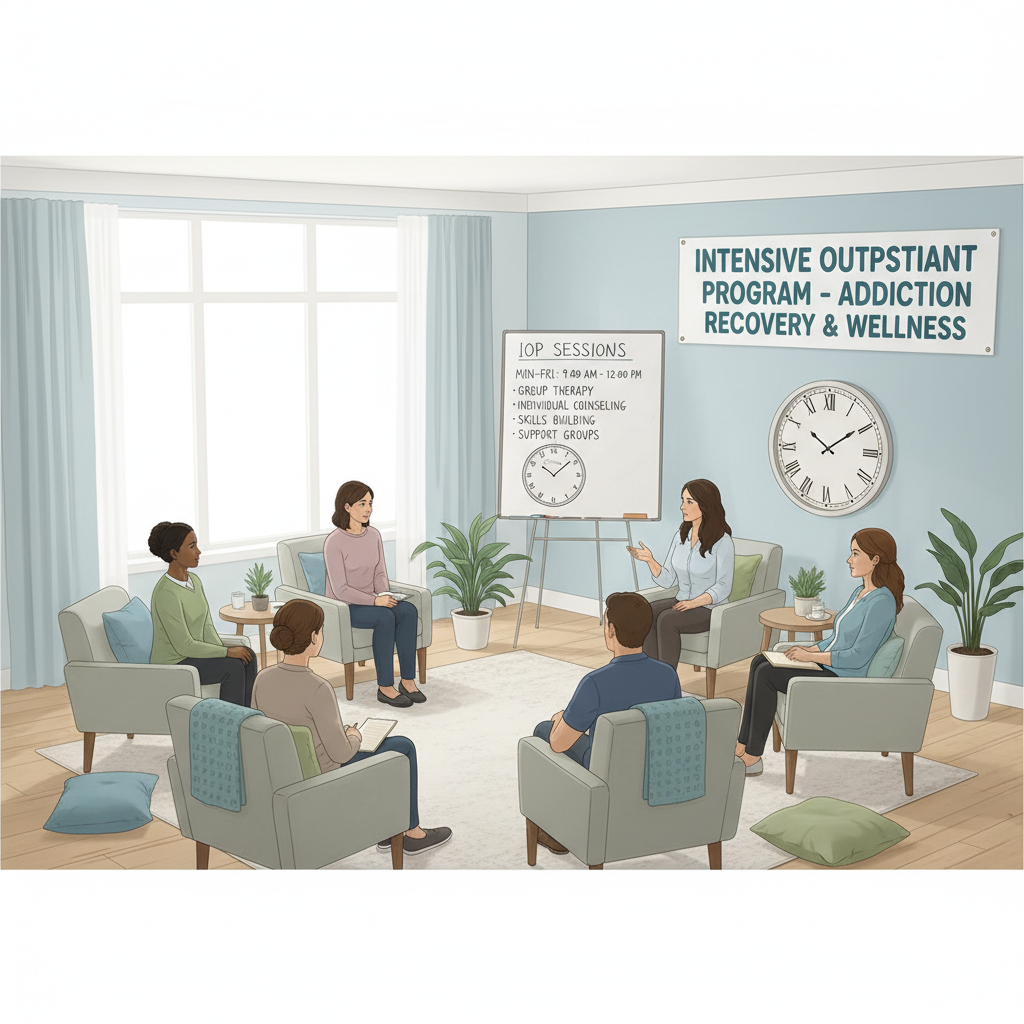
- Three to five treatment days per week, often Monday through Friday
- Sessions that last two to four hours, sometimes slightly longer early in treatment
- A minimum of nine hours per week, with some programs providing higher intensity care if needed [1]
Many programs are intentionally flexible. IOP sessions may be offered:
- In the morning, so you can attend before work or school
- In the afternoon, if that fits better with childcare or shift work
- In the evening, to support a standard daytime work schedule [1]
That flexibility is one of the reasons IOP often works well if you are trying to maintain employment or other responsibilities. You can explore this question in more detail on the page that answers, can you work while in an intensive outpatient program.
How intensity changes over time
Your IOP schedule is not fixed forever. As you make progress, the frequency or duration of your sessions may change.
Some providers outline a progression like this:
- Early in treatment, sessions might be more frequent, sometimes approaching daily meetings.
- As you stabilize and build skills, the schedule often steps down to three to five days per week, with two to four hour sessions [2].
- Over time, you may transition into a less intensive outpatient level of care that still provides support but fits into an even smaller weekly time commitment.
This gradual shift is important. It allows you to practice recovery skills in real life while still having consistent contact with a clinical team.
For a closer look at scheduling patterns and how your time might be structured, you can review the guide to addiction recovery intensive outpatient structure.
What happens during your IOP hours
Knowing how many hours an intensive outpatient program will take is only half the picture. You also need to understand what actually fills those hours.
Core therapy components
During IOP you usually participate in a combination of:
- Group therapy, where you explore triggers, coping skills, relationships, and relapse prevention with peers
- Individual therapy, focused on your personal history, trauma, mental health, and specific recovery goals
- Psychoeducation sessions, which help you understand addiction, the brain, and the recovery process
- Family or couples sessions, when appropriate, to improve communication and support at home
Many programs rely on evidence based approaches, such as cognitive behavioral therapy, motivational interviewing, and relapse prevention work. A structured mix of these modalities is part of what makes IOP more intensive than basic outpatient therapy.
For a deeper look at session types, you can visit the page on intensive outpatient program therapy structure.
Skills building and recovery planning
In addition to formal therapy, part of your IOP hours might include:
- Practicing coping skills for cravings and high risk situations
- Learning stress management approaches, such as mindfulness or relaxation techniques
- Building problem solving skills for day to day challenges
- Developing a relapse prevention plan and crisis plan
- Receiving support with practical issues that affect recovery, such as work stress or housing instability
This blend of clinical work and practical skill building is designed to help you apply what you learn as you move through your week outside of treatment.
If you want a step by step look at how all of this unfolds, the guide on steps in an intensive outpatient program explains the process in more detail.
How IOP compares to inpatient and standard outpatient care
When you weigh your options, it helps to see how intensive outpatient programs fit between other levels of care in terms of hours, structure, and support.
IOP versus inpatient rehab
Inpatient or residential rehab requires you to live at the facility with 24 hour supervision. You may spend most of your waking hours in therapy, groups, or related activities each day. This is the highest intensity level of care and is usually recommended if you:
- Need medical detox or close medical monitoring
- Have very unstable symptoms or high risk of harm
- Lack a safe or sober place to live
By contrast, an IOP:
- Involves a few hours per day, three to five days per week, instead of full days and nights
- Allows you to sleep at home and maintain outside responsibilities
- Still gives you structured, multi day support and accountability each week
If you are deciding between these levels, you may find the comparison on IOP vs inpatient rehab helpful.
IOP versus standard outpatient addiction treatment
Traditional outpatient therapy, or standard outpatient addiction treatment, usually involves:
- One weekly individual counseling session
- Or one to two group sessions per week
- Typically one to three hours of care weekly
Intensive outpatient treatment offers a much higher level of structure and contact. In an IOP you receive:
- At least 9 hours of services per week
- Multiple group and individual sessions
- Ongoing monitoring and adjustment of your treatment plan
For some people, standard outpatient care is not enough to stabilize early recovery, but inpatient care feels too disruptive. IOP provides a middle path. The page on IOP vs outpatient addiction treatment explores this comparison more fully.
Who IOP is usually best for
To decide whether IOP is appropriate, it helps to look at common criteria that programs use when recommending this level of care.
You may be a good fit for intensive outpatient treatment if:
- You are medically stable and do not need 24 hour supervision
- You have a relatively safe and substance free place to live
- You are able to attend several treatment sessions per week consistently
- You are motivated to engage in therapy and follow a recovery plan
- You may be stepping down from inpatient rehab and still need structured support
Programs also consider:
- The severity of your substance use
- The presence of co occurring mental health conditions
- Your history of relapse
- The strength of your support system
For a more detailed discussion of common eligibility factors, you can look at who qualifies for intensive outpatient treatment and who should attend an intensive outpatient program.
How IOP hours support your recovery
You might wonder if a few hours per day are really enough to make a difference. The structure of intensive outpatient programs is designed to strike a balance between support and real life practice.
Balancing treatment and daily responsibilities
A key advantage of IOP is that it allows you to:
- Continue working, going to school, or caring for family
- Sleep in your own home and practice living sober in your usual environment
- Bring real life challenges back into therapy each week to process and problem solve
Providers emphasize that IOPs allow clients to live at home and balance work, since treatment does not require 24 hour inpatient supervision. This makes intensive outpatient care especially suitable if you need to maintain daily obligations while still receiving comprehensive treatment [2]. Similar points are noted by other programs that highlight how IOPs allow participants to maintain daily responsibilities such as work, school, and family life while in care [1].
You can read more about how this balance works in practice on the page that explains how intensive outpatient treatment works.
Clinical benefits of consistent weekly hours
From a clinical perspective, the weekly hours you spend in IOP:
- Provide repeated contact with therapists who can monitor your symptoms and progress
- Allow enough time to cover multiple topics, not just crisis management
- Help you build peer support within your groups
- Create a structured rhythm in your week anchored in recovery
Programs that customize IOP length and intensity based on ongoing assessment often allow some people to transition to less intensive care sooner or extend treatment duration if they need more support [3]. This flexibility helps match the total number of treatment hours to what you actually need.
If you want to understand the broader impact of this structure, you can explore how IOP helps addiction recovery and how intensive outpatient therapy helps addiction.
What to expect from your time in IOP
Knowing what will fill the hours of your intensive outpatient program can make the commitment feel more concrete and less overwhelming.
During a typical week you can expect to:
- Attend multiple group sessions focused on triggers, coping skills, communication, and relapse prevention
- Meet individually with a therapist to work on personal goals and any co occurring mental health concerns
- Engage in educational sessions about addiction, mental health, and recovery
- Participate in check ins about cravings, mood, and risk factors
- Work on assignments or practice skills between sessions and discuss what worked and what did not
You might also participate in family meetings, medication management appointments, or coordination with other providers as needed.
For a more detailed preview of the day to day experience, you can visit what to expect in an IOP program and what is an intensive outpatient program.
The hours you spend in IOP are not just time blocks on a calendar, they are structured opportunities each week to practice new ways of thinking, feeling, and responding to challenges in real life.
Key questions to help you decide if IOP is right for you
As you weigh your options, it can help to ask yourself a few practical questions about the time commitment and structure.
Consider:
- Can you realistically attend three to five treatment days per week for several weeks?
- Do you have enough flexibility in your work, school, or family schedule to commit to two to four hour sessions on those days?
- Is your living situation safe enough to support recovery while you are not at the treatment center?
- Do you feel that weekly individual therapy alone is not enough structure, but 24 hour inpatient care is more than you need right now?
- Are you willing to participate actively in group work, homework, and skill practice between sessions?
If you answer yes to many of these questions, an intensive outpatient program could be an appropriate level of care. The pages on when to choose intensive outpatient rehab and benefits of intensive outpatient treatment can help you think through this decision further.
Putting it together: how many hours is an IOP really
When you put all of this information together, a realistic picture of an intensive outpatient program looks like this:
- Weekly hours: Usually at least 9 hours per week, often more, delivered across 3 to 5 days.
- Session length: Typically 2 to 4 hours per session, sometimes longer in higher intensity phases.
- Overall duration: Commonly 8 to 12 weeks at minimum, often 90 days or longer, and sometimes extended based on individual needs and progress [4].
- Flexibility: Scheduling is often tailored to allow you to keep working, going to school, or caring for family while you are in treatment [1].
There is no one size fits all answer, because reputable programs adjust the number of hours and weeks to match your situation. What remains consistent is the goal, to provide enough structured support each week to help you build a stable, sustainable recovery while staying connected to your everyday life.
If you are still weighing options or wondering whether this level of commitment is likely to be effective for you, you might find it helpful to explore how effective are intensive outpatient programs and iop program requirements before making a final decision.