
Understanding how intensive outpatient therapy helps addiction
If you are comparing levels of care, you might be wondering exactly how intensive outpatient therapy helps addiction recovery and where it fits between inpatient rehab and standard outpatient counseling. Intensive outpatient programs, often called IOPs, bridge the gap. They give you more structure and support than weekly therapy, while still allowing you to live at home and maintain many of your responsibilities.
IOP is not a watered‑down version of rehab. Research shows that when you receive the right level of care, intensive outpatient treatment can be as effective as inpatient or residential programs in reducing alcohol and drug use and increasing abstinence at follow‑up checks of 3 to 18 months [1]. Understanding how these programs work can help you decide whether this is the right step for you.
If you want a deeper dive into logistics, you can also review what an IOP is in more detail in our guide on what is an intensive outpatient program.
What intensive outpatient therapy is and how it works
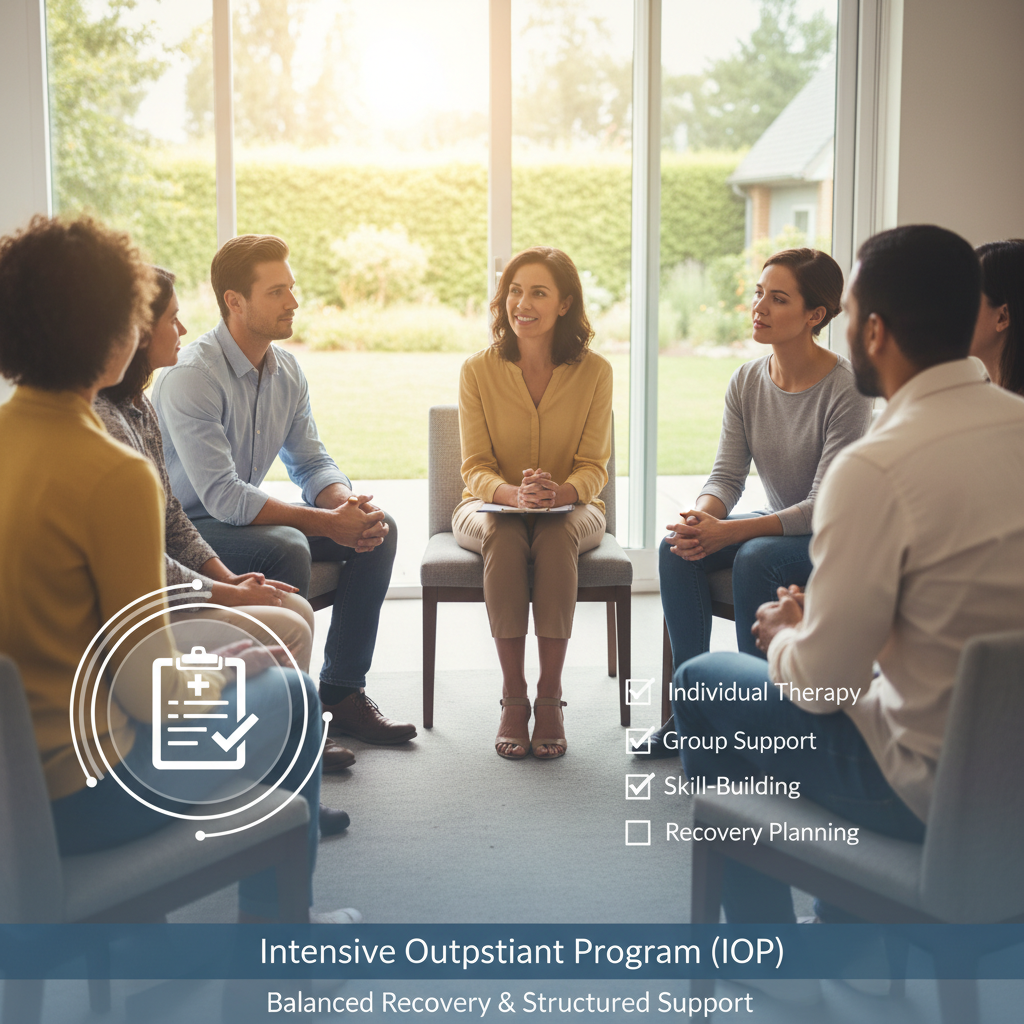
Intensive outpatient therapy is a structured treatment approach for substance use disorders that provides frequent sessions each week without overnight stays. Most IOPs include a mix of individual counseling, group therapy, educational sessions, and relapse prevention planning.
Studies define substance use IOPs as delivering at least 9 hours of treatment per week, usually through a combination of group and individual services [1]. Many programs schedule three 3‑hour sessions each week, which is more intensive than standard outpatient but less restrictive than inpatient care [2].
During an IOP, you typically:
- Attend frequent group therapy and skills sessions
- Meet individually with a therapist or counselor
- Participate in psychoeducation on addiction, mental health, and coping
- Develop and update a structured relapse prevention plan
- Receive monitoring and support for medications if needed
You return home or to a sober living environment after each session. This format lets you apply what you learn right away in real‑world situations and then bring challenges back to the group for feedback.
To understand the nuts and bolts in more depth, visit our overview of how intensive outpatient treatment works.
Typical intensive outpatient program schedules
IOPs are designed to be intensive while respecting that you have commitments at home, school, or work. Most programs organize treatment time in blocks that repeat each week.
Many IOPs follow a pattern similar to this:
- Three days per week, often Monday, Wednesday, and Friday or Tuesday, Thursday, and Saturday
- Around 3 hours per session, for a minimum of 9 hours per week
- Sessions scheduled in the morning or evening to support work and family responsibilities
This structure is consistent with research that defines IOPs as providing at least 9 hours per week of services [1] and with clinical programs that commonly use three 3‑hour blocks [2].
If you want to see how these hours are arranged in practice, you can explore our guides on how many hours is an intensive outpatient program and a sample intensive outpatient program schedule for addiction.
An evening IOP schedule can also answer a common question: can you work while in an intensive outpatient program. Many people do, and programs are often designed with this need in mind.
Therapy structure inside an intensive outpatient program
What happens during those hours is what truly explains how intensive outpatient therapy helps addiction recovery. IOPs rely on a set of evidence‑based services that work together to address the physical, psychological, and social sides of substance use.
Core therapies and services
Most intensive outpatient programs use a mix of:
- Individual counseling to work on your personal history, triggers, and goals
- Group therapy to share experiences, practice skills, and receive feedback
- Cognitive behavioral therapy to identify and change thoughts and behaviors that keep you stuck
- Motivational interviewing to strengthen your commitment to change
- Psychoeducation that covers addiction science, relapse warning signs, and healthy coping
- Family services that help loved ones understand addiction and support your recovery
- Case management, which can include help with housing, work, or legal issues
- Drug and alcohol monitoring for accountability when needed
These services are not random. Research shows that IOPs that include individual and group counseling, CBT, motivational interviewing, family therapy, and medication support have strong evidence for effectiveness, with outcomes comparable to inpatient treatment for many people [3].
A closer look at cognitive behavioral therapy
Cognitive behavioral therapy is one of the most common components of IOP. In CBT, you learn to:
- Notice unhelpful thoughts that lead to cravings or risky situations
- Challenge those thoughts and replace them with more realistic ones
- Build healthy routines and problem‑solving skills
- Practice new behaviors in and out of sessions
Because you are living at home or in the community during IOP, you get daily chances to test CBT skills. For example, you might use strategies to avoid a high‑risk place, then discuss how it went in group the next day.
To see how all of these elements fit together across a full program, you can review our breakdown of intensive outpatient program therapy structure and the steps in an intensive outpatient program.
How intensive outpatient therapy compares to inpatient care
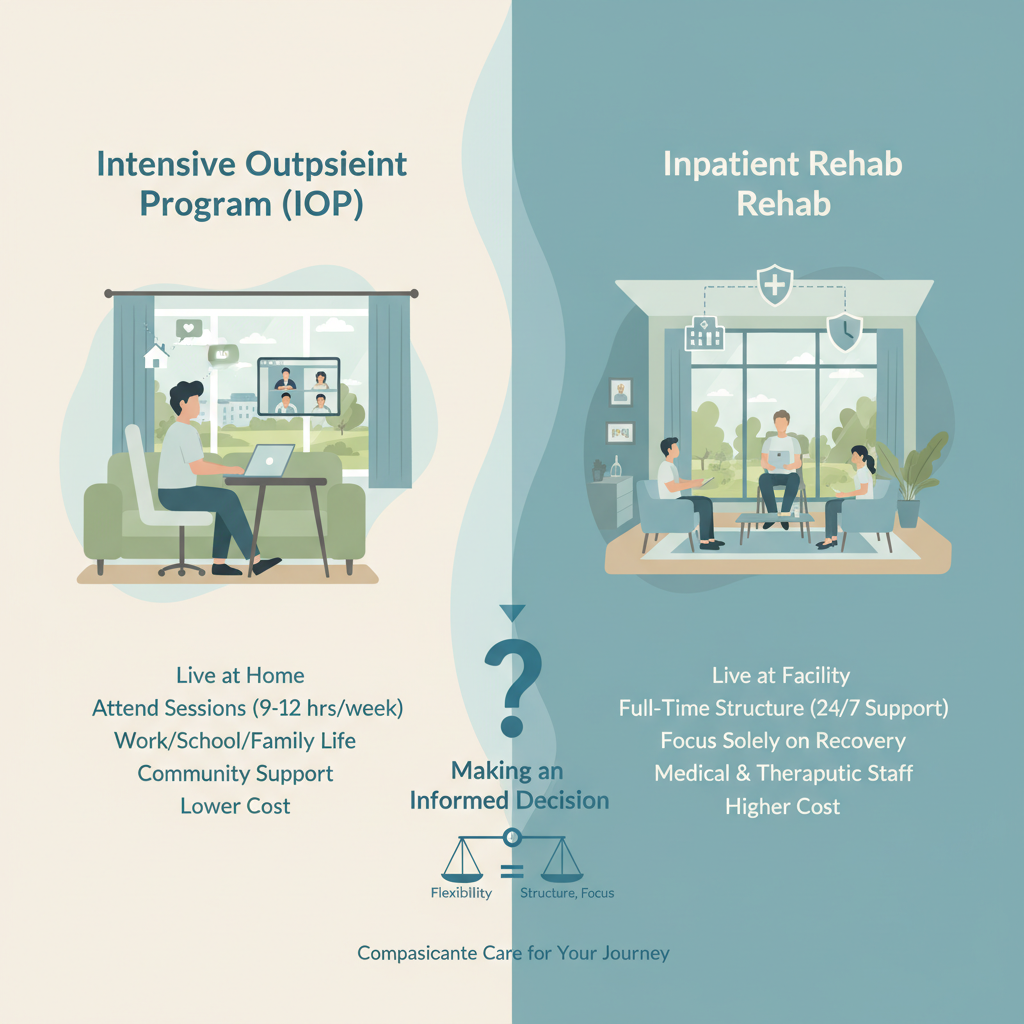
As you evaluate how intensive outpatient therapy helps addiction, you are likely comparing it to inpatient or residential treatment. Both levels of care use many of the same therapies, but the setting and structure are different.
Research shows that:
- Residential and inpatient programs tend to have higher treatment completion rates than outpatient care overall. One large U.S. dataset found residential clients were more than three times as likely to complete treatment as outpatient clients [4].
- At the same time, multiple randomized and naturalistic studies from 1995 to 2012 found that IOP outcomes for alcohol and drug use and abstinence are comparable to inpatient or residential treatment for many individuals when the level of care matches the severity of the illness [1].
In other words, inpatient care can be especially valuable when your situation is very severe or unstable, but intensive outpatient treatment can work just as well as inpatient for many people who do not need 24‑hour supervision.
One key advantage of IOP is that it lets you practice recovery skills in your actual environment throughout treatment. Studies note that this home‑based engagement helps you apply coping and relapse prevention strategies in real situations and adjust the treatment plan accordingly [1].
For a side‑by‑side look at similarities and differences, you can visit our comparison of iop vs inpatient rehab.
How IOP differs from standard outpatient addiction treatment
Intensive outpatient therapy is more structured than traditional outpatient counseling. Standard outpatient often involves one individual session per week, sometimes with occasional groups. IOP multiplies that therapy time and adds more structure and accountability.
Key differences include:
- Frequency: IOP usually involves at least 9 hours per week. Standard outpatient is often 1 to 3 hours.
- Structure: IOP follows a planned schedule of groups, education, and individual sessions. Outpatient can be more flexible and less intensive.
- Focus on relapse prevention: IOP includes regular relapse‑prevention work and monitoring. Outpatient relies more on what you bring to sessions.
Studies highlight that IOPs sit between weekly outpatient and inpatient, providing a level of intensity that is often sufficient for many people who would otherwise need residential care [1].
If you are weighing these two levels of care, our guide on iop vs outpatient addiction treatment can help clarify which one fits your situation.
Who intensive outpatient therapy is best for
You get the most benefit from IOP when the level of care matches what you need. Intensive outpatient treatment is generally a good fit when:
- You do not need medical detox or 24‑hour medical supervision
- You have some stability in housing and basic needs
- You can safely manage cravings between sessions with support
- You are motivated to attend regular groups and therapy
- You want to keep working, going to school, or caring for family while in treatment
Guidelines and research suggest that IOP is appropriate for people who need more support than weekly counseling but do not require the structure of inpatient care [3].
To decide whether this applies to you, it can help to look at specific criteria for who qualifies for intensive outpatient treatment and who should attend an intensive outpatient program.
If your substance use is very severe, or if you have a history of serious withdrawal, you may need inpatient treatment or medical detox before stepping down to IOP. Some studies show that inpatients with severe substance use disorders are more likely to complete treatment, which can be especially important early on [5].
How intensive outpatient therapy supports long‑term success
Substance use disorders are chronic conditions for many people, which means that recovery is often a long‑term process. Relapse rates are estimated at 40 to 60 percent, similar to other chronic illnesses such as diabetes or hypertension [6]. This does not mean treatment has failed. It means that ongoing care and adjustments are often needed.
Intensive outpatient therapy helps addiction recovery succeed over the long term in several ways:
-
Extended contact with treatment
IOPs can run for several weeks to several months, which gives you enough time to build habits and stability. Longer treatment exposure is associated with better outcomes when you remain engaged [6]. You can learn more about timelines in our resource on how long does an iop program last. -
Practice in real‑world situations
Because you are living at home or in the community, you encounter stressors and triggers during treatment. You then bring that experience back into group or individual sessions, which allows you to troubleshoot in real time. Research notes that this real‑life practice of coping and relapse prevention skills is a specific strength of IOP compared to inpatient settings [1]. -
Focus on aftercare and support networks
Many IOPs help you build connections to community resources, mutual‑help groups, and alumni programs before you finish. Staying involved in recovery communities and maintaining lifestyle changes after treatment can reduce relapse risk [6]. -
Individualized treatment planning
Successful addiction treatment is tailored. Programs that combine the right therapies and medications for your situation and support you through completion show the best outcomes [6]. IOPs are well suited to this customization because staff see you several times per week and can adjust the plan quickly.
If you are asking yourself more generally how iop helps addiction recovery, it is this combination of structured therapy, real‑world practice, and continued support that often makes the difference.
When you stay engaged and complete an appropriate course of treatment, most people in addiction programs reduce or stop substance misuse, lower criminal activity, and improve social and psychological functioning over time [6].
When to choose intensive outpatient rehab
Knowing when to move into IOP can be as important as knowing how intensive outpatient therapy helps addiction in general. You might consider IOP if:
- You are stepping down from inpatient or residential rehab and want continued structure
- You have completed detox and need an organized next step
- Weekly counseling is not enough, and you are still relapsing or struggling between sessions
- You need support but cannot leave work or family for a full residential stay
Research emphasizes that IOPs can serve several roles: as an entry point after detox, as a step‑down from inpatient rehab, as a step‑up from standard outpatient, or as a bridge back into everyday life while keeping structured support [2].
If you are actively trying to decide, our guide on when to choose intensive outpatient rehab can help you weigh timing and readiness.
IOP programs also have expectations, such as attendance, participation, and in some cases drug testing. Reviewing typical iop program requirements and what to expect in an iop program can help you prepare.
How effective intensive outpatient programs are
A common concern is whether you are risking your recovery by not choosing the highest level of care available. Existing evidence provides reassurance, as long as you choose a level that matches your needs and stay engaged.
- Comprehensive reviews of studies from 1995 to 2012 found that substance use IOPs have a high level of evidence for effectiveness, with outcomes similar to inpatient care for many participants [1].
- Research summarized in 2014 concluded that intensive outpatient treatment is as effective as inpatient treatment for most individuals with alcohol and drug use disorders, underlining the role of IOPs as a crucial part of the continuum of care [1].
- American Addiction Centers reports that people who complete intensive outpatient programs do just as well as those who complete inpatient treatment, when the care level is well matched to their needs [2].
At the same time, studies also show that many people entering treatment do not complete their programs. Completion rates across addiction treatment are less than 43 percent in some data, which highlights the need for engaging and supportive programs to keep you involved through the full course of care [6].
If you want more detail on outcomes, you can review our article on how effective are intensive outpatient programs and explore specific benefits of intensive outpatient treatment.
Deciding whether intensive outpatient therapy is right for you
When you step back from the details, the ways that intensive outpatient therapy helps addiction recovery become clearer. It gives you:
- A structured, evidence‑based therapy schedule without overnight stays
- Enough intensity to make real change but enough flexibility to maintain your life
- Ongoing opportunities to test and refine coping skills in real situations
- A bridge between higher and lower levels of care as your needs change
If you are unsure whether this level is right for you, it can help to:
- Meet with a professional for a formal assessment.
- Discuss your history, current substance use, mental health, and safety concerns.
- Ask directly whether IOP, inpatient rehab, or standard outpatient seems most appropriate for your current situation.
You can also explore our resources on addiction recovery intensive outpatient structure and how intensive outpatient therapy helps addiction to see how this level of care might fit into your larger recovery plan.
Choosing a level of care is not a one‑time decision. As you stabilize, you can move from inpatient to IOP, then to standard outpatient and long‑term support. The important step is choosing a starting point that gives you enough structure and safety, and then staying engaged long enough for treatment to work.