Online IOP Program in New Jersey: How Virtual Intensive Outpatient Treatment Actually Works
You found a program that offers an online IOP program, but you are not asking whether it is convenient, you are asking whether it is real treatment. That question deserves a straight answer, because an online IOP program in New Jersey is not a video call with a counselor once a week. When it is delivered by a state-licensed facility, virtual intensive outpatient treatment carries the same clinical intensity, the same 15 weekly hours, and the same insurance recognition as walking into an office. What follows is exactly how it works, step by step, so you can decide with your eyes open instead of guessing.
Resilience Recovery Center runs this program from Fair Lawn under New Jersey oversight, which means the treatment reaches you at home but never leaves the state’s clinical standards behind. You keep your job. You keep your schedule. You participate in treatment while maintaining your real-world responsibilities.
What Qualifies You for an Online IOP Program in New Jersey (Prerequisites)
You may qualify for virtual IOP when you no longer need medical detox or round-the-clock supervision and you can participate safely from home. Intensive outpatient care is built for people who are medically stable but still need structured, high-frequency support as part of their recovery.
The clinical standard here is the American Society of Addiction Medicine’s level 2.1 placement criteria, the benchmark used to match a person to the right intensity of care. Level 2.1 assumes your withdrawal is managed, your living environment is safe enough to support recovery, and your day-to-day functioning is intact enough that you do not require a residential bed. If you are still in active withdrawal or facing acute medical risk, IOP may not be the starting point, and a program will tell you that during assessment and refer you to a trusted medical detox partner first. Resilience does not provide detox itself, which is why that referral relationship matters.
New Jersey holds virtual programs to the same standard as in-person ones. Resilience’s licensure and DMHAS approval means every telehealth session must meet the same documentation and clinical intensity requirements as a session held in the Fair Lawn office. When you log in from your kitchen table, you are entering a licensed program, not a national app that happens to serve New Jersey. That distinction matters for your insurance, for the courts, and for whether the hours you attend actually count.
Step 1: How Does Insurance Verification and the Clinical Assessment Work?
The first step is a clinical assessment that determines your ASAM level of care, paired with an insurance verification that confirms your telehealth coverage. Insurance carriers in New Jersey recognize telehealth IOP under the same prior authorization and utilization review criteria they apply to in-person attendance.
Resilience accepts Blue Cross Blue Shield, Aetna, Cigna, and UnitedHealthcare. Before your first session, the team verifies your benefits so you know what your plan covers rather than discovering a surprise later. During the intake call at Resilience, clients routinely ask whether their plan will cover virtual sessions the same way it covers walking through the door, and the answer consistently comes back from the billing team within 24 hours: if your plan covers IOP, it covers the telehealth version under the same authorization.
The assessment itself is a conversation, not an interrogation. A licensed clinician asks about your substance use history, your mental health, your work and family responsibilities, any past treatment, and your current safety. From that, they place you at the appropriate level using ASAM criteria and build a personalized treatment plan around your actual life rather than a one-size-fits-all track. If you are a working adult worried that admitting a problem will affect your job or your standing, this is where that concern gets addressed directly, with respect for your dignity. The point of the assessment is to design care that fits around your responsibilities, not to pull you out of them.
Step 2: What Does a Week of Virtual IOP Actually Look Like?
A full week of virtual IOP is 15 hours of programming, three hours a day, Monday through Friday, following a structured rotation of evidence-based modalities. You are not logging in to an open-ended chat. Each day has a defined focus that repeats week to week.
Monday is CBT relapse prevention. Tuesday is DBT skills. Wednesday addresses co-occurring disorders and mental health. Thursday covers life skills and recovery planning. Friday runs process group and recovery maintenance. Because the schedule repeats, you can plan your work week around the same three-hour block instead of scrambling to figure out what is happening each day.
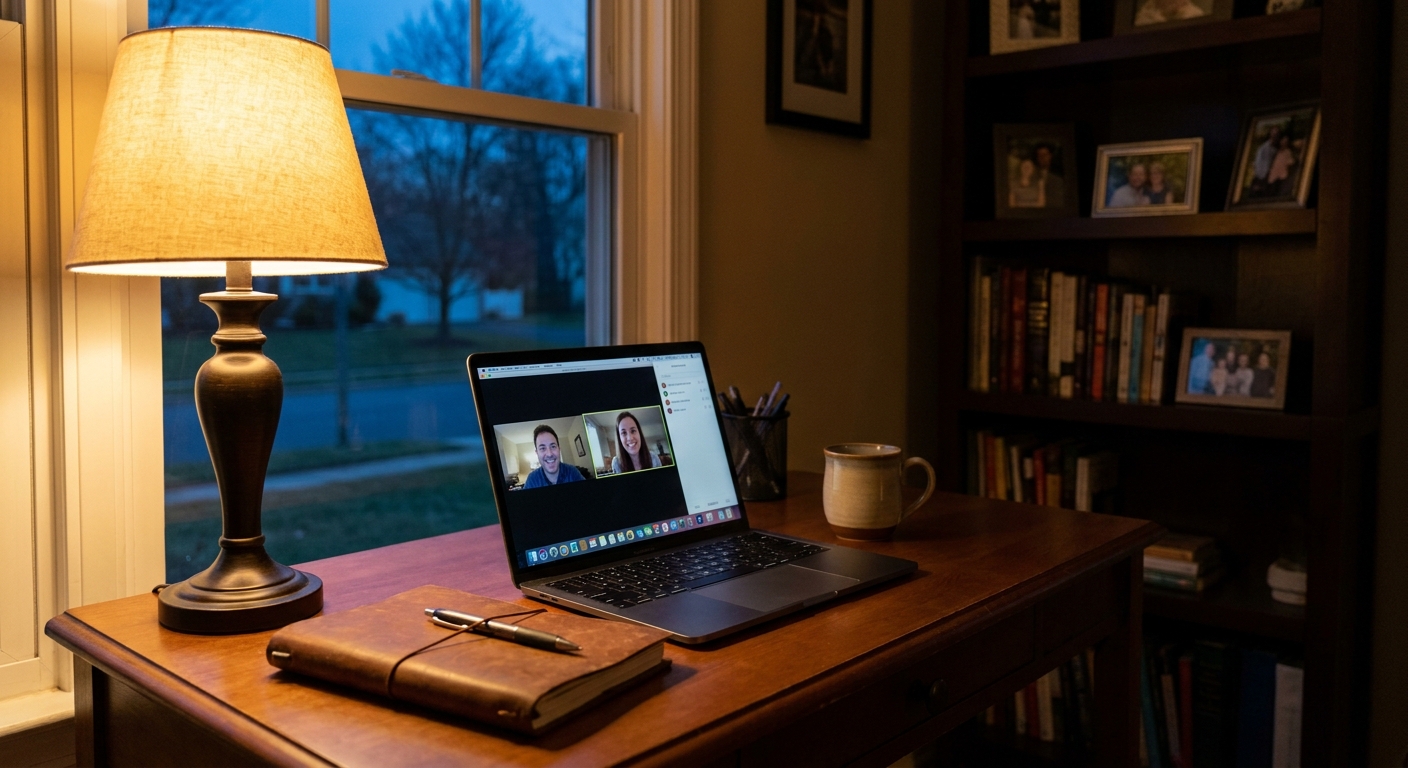
The technology requirements are modest: a private space, a stable internet connection, and a device with a camera. To accommodate people who work full time in Fair Lawn and across Bergen County, evening sessions run from 6:00 PM to 9:00 PM, and a morning track runs 9:00 AM to 12:00 PM. That evening window is deliberate, because it lets you finish a shift, get home, and still attend a full clinical session without asking your employer for time off or explaining where you go three afternoons a week. For someone concerned about privacy, that scheduling is not a small detail. It can be the difference between getting help and putting it off another year.
Step 3: What Happens During Your First Virtual Group Session?
Your first session is a structured group therapy meeting, not a one-on-one video appointment. You join a group of other participants, and a clinician leads the room through check-ins, a skill-building exercise tied to that day’s focus, and processing time where members work through what is actually happening in their lives.
Sessions are facilitated by dual-licensed therapists holding LCADC, LAC, or LSW credentials, along with CADC counselors and peer recovery specialists. All of it runs under the clinical oversight of Clinical Director Tammy Nussbaum, a Licensed Clinical Alcohol and Drug Counselor who also holds a Certified Clinical Supervisor credential. This is a coordinated team rotating through the weekly curriculum, not a single counselor improvising on camera.
Expect the format to feel structured from the first check-in. The facilitator opens by taking the temperature of the room, then teaches or reviews a concrete skill, then opens the floor so members can apply it to real situations. In practice, the first ten minutes of a Monday evening session typically involve each participant naming what happened since Friday and identifying one trigger or challenge they are carrying into the week. The clinician then introduces the CBT relapse prevention skill for that session, walks through it on screen with examples, and the group spends the remaining time applying it to their own situations. The virtual format preserves what makes group work, which is other people who understand what you are carrying, without the concern of walking through a clinic door where someone might recognize you.
Step 4: How Do Individual Counseling and Psychiatric Follow-Up Fit In?
Individual therapy and medication follow-up are scheduled separately from your group sessions and can also be completed virtually. This keeps your one-on-one work private and lets a prescriber manage the medical side of recovery without adding another trip across town.
Psychiatric follow-up is overseen by a Medical Director who is an MD and psychiatrist. If you are receiving medication-assisted treatment or managing a co-occurring condition such as anxiety or depression alongside a substance use disorder, those appointments integrate into your IOP schedule rather than sitting in a separate silo. Resilience coordinates MAT with an accountability and education focus rather than operating as a stand-alone prescriber, keeping the medical side and the therapeutic side aligned as your needs change.
The value of doing this by telehealth is practical. One client at Resilience scheduled his monthly psychiatric check-in during his lunch break, logged in from his car parked at a job site, completed the fifteen-minute medication review with the prescriber, and returned to work without his supervisor knowing he had left. That level of discretion would not have been possible if every appointment required a 45-minute round trip to Fair Lawn during business hours.
Step 5: How Does Drug Screening Work When You Attend Online?
Drug screening still happens, and in a virtual model it usually means coming in for observed collection on a set day while completing everything else remotely. Some probation or licensing board requirements may specifically mandate in-person attendance or supervised testing, so the program builds around that.
One client who works mornings straight into the night most of the week but has Fridays off committed to one in-person group each Friday, coming in for that session and his drug test, and completed his individual counseling and medical appointments by telehealth during the week. That single structure let him meet screening requirements and stay accountable without sacrificing his income or asking for time off he could not afford to take.
This is where a state-licensed local program differs from a generic national platform. Because Resilience operates from a physical Fair Lawn location at ASAM level 2.1, hybrid participation is possible within the same program week. You can do most of your treatment online and still satisfy observed testing, court documentation, or licensing board requirements in person, all under one treatment plan.
Step 6: Can You Move Between Virtual and In-Person Without Re-Enrolling?
Yes. An online IOP program is not a separate program, it is a parallel track inside the same licensed facility, so you can shift between virtual and in-person attendance as your life changes without starting over. Your treatment plan, your clinical team, and your insurance authorization stay intact.
If your work schedule shifts and you suddenly have mornings free, you can move from evening virtual sessions to in-person groups at the Fair Lawn office. If a busy stretch at work makes commuting impossible, you flip back to telehealth. You can even attend some sessions virtually and others in person within a single week, exactly as the Friday-only client did, and nothing about that requires new paperwork or a new authorization.
This flexibility protects what working adults often value most, which is momentum. Every time treatment forces a hard choice between recovery and a paycheck, the paycheck usually wins and the recovery stalls. By letting the format bend to your week instead of the other way around, continuous care stays possible even when your schedule is not.
Step 7: When Do You Step Down to Outpatient or Step Up to a Higher Level of Care?
You transition levels of care when ASAM criteria show your needs have changed, either because you are stable enough to reduce intensity or because you need more support than IOP provides. This is a clinical decision, not a fixed timeline.
Many people attend 15 hours per week for roughly 8 to 12 weeks before stepping down, though individual timelines vary. Standard outpatient care typically runs 6 to 9 hours per week and may be appropriate once you show sustained progress: consistent attendance, negative drug screens, easing cravings, and steady engagement. Aftercare and continuing care groups then help maintain that progress while you rebuild the practical side of your life, supported by the housing network, vocational and job placement services, and case management that Resilience coordinates alongside clinical treatment.
The step can also go up. If virtual IOP is not intensive enough, because relapse risk is high, the home environment lacks structure, or co-occurring psychiatric symptoms intensify, the clinical team may recommend a higher level of care through a trusted partner. That is not failure. It is the system working as designed, matching your care to your reality so you are neither under-treated nor over-treated at any point.
Common Questions About Online IOP in New Jersey
Does insurance cover an online IOP program the same way it covers in-person treatment? Yes. Carriers recognize telehealth IOP under the same prior authorization and utilization review criteria as in-person programming when it is delivered by a state-licensed facility.
Can I attend some sessions virtually and others in person in the same week? Yes. Resilience allows hybrid participation, so you can complete group sessions by telehealth and come in for drug testing or individual appointments without re-enrolling.
Will a probation officer or licensing board accept virtual attendance? Some probation and licensing authorities in New Jersey accept telehealth IOP attendance from a DMHAS-approved facility, but confirm your specific requirements with your officer or board before enrolling.
What happens if I experience a setback during online IOP? The clinical team reassesses your ASAM level of care and may recommend increasing individual counseling or stepping up to a higher level of care based on severity and safety.
Do I need to live in New Jersey to attend? Yes. New Jersey licensing requires that participants reside in the state and that the clinical team hold active New Jersey credentials to provide these services.
How long does online IOP last before step-down? Duration varies with your progress and ASAM criteria, but many people attend 15 hours per week for 8 to 12 weeks before moving to standard outpatient or continuing care, though individual paths differ.
Call Resilience Recovery Center in Fair Lawn at the number on this page to complete a clinical assessment, verify your insurance for an online IOP program, and schedule your first virtual group session this week. The fastest way to know whether virtual treatment fits your life is to let a licensed clinician map it to your actual schedule, not to keep weighing it alone. That single conversation often reveals what months of waiting never will: that recovery and your responsibilities can share the same calendar.
Ready to Learn More About Virtual IOP?
If you’ve been wondering whether online treatment can offer the structure and support you need while fitting into your daily life, you’re not alone in weighing that decision. Resilience Recovery Center in Fair Lawn, NJ offers intensive outpatient programming designed around real schedules and real recovery. Reach out today to discuss whether virtual IOP might be the right fit for where you are right now.
Call Resilience Recovery Center
Individual experiences with treatment vary. The client story described reflects one person’s participation in the program and should not be considered typical or predictive of any specific outcome.