Legal Coordination Recovery Support for Clients in Fair Lawn, NJ
Your probation officer needs proof you attended last week’s sessions by Friday. Your attorney requested a compliance letter for your DUI hearing. Your court-mandated drug test is scheduled the same morning as your IOP group. And you are expected to coordinate all three while keeping your job and showing up for your family. That is the exact pressure legal coordination recovery in Fair Lawn is built to take off your shoulders. At Resilience Recovery Center, a case manager stands between you and that pile of competing deadlines, so meeting your court obligations and meeting your treatment goals stop pulling against each other and start moving in the same direction.
What Does Legal Coordination Support Actually Mean in Treatment?
Legal coordination support means a case manager actively communicates with courts, probation officers, and attorneys on your behalf while aligning your IOP schedule, drug testing, and documentation, so your legal obligations and your treatment do not fight over the same hours in an already stretched week. It is not a stack of form letters handed to you at discharge. It is ongoing, hands-on coordination that runs the length of your care.
Think of it like this. Most people facing a DUI, probation, or a Family Court matter are trying to be three people at once: the employee who cannot miss a shift, the client who has to make group, and the defendant who has to satisfy the court. When those three roles collide, something gets dropped, and usually the thing that gets dropped is the one with the harshest penalty. A missed probation check-in or a late compliance letter can undo weeks of real progress.
Legal coordination closes that gap. Your case manager knows your court date, your drug testing window, your work hours, and your treatment schedule, and they arrange those pieces so they stop overlapping. When your attorney needs verification, it goes out on time. When your probation officer needs proof of attendance, it is ready. Coordinating health, social, and support services under one plan is a recognized recovery principle, reflected in federal frameworks that treat health and social services coordination as a distinct recovery support function. For you, it means one point of contact instead of a dozen loose ends. This is a judgement free zone, and the goal is a softer landing while you meet what the court requires.
Who Manages Legal Coordination at Resilience Recovery Center?
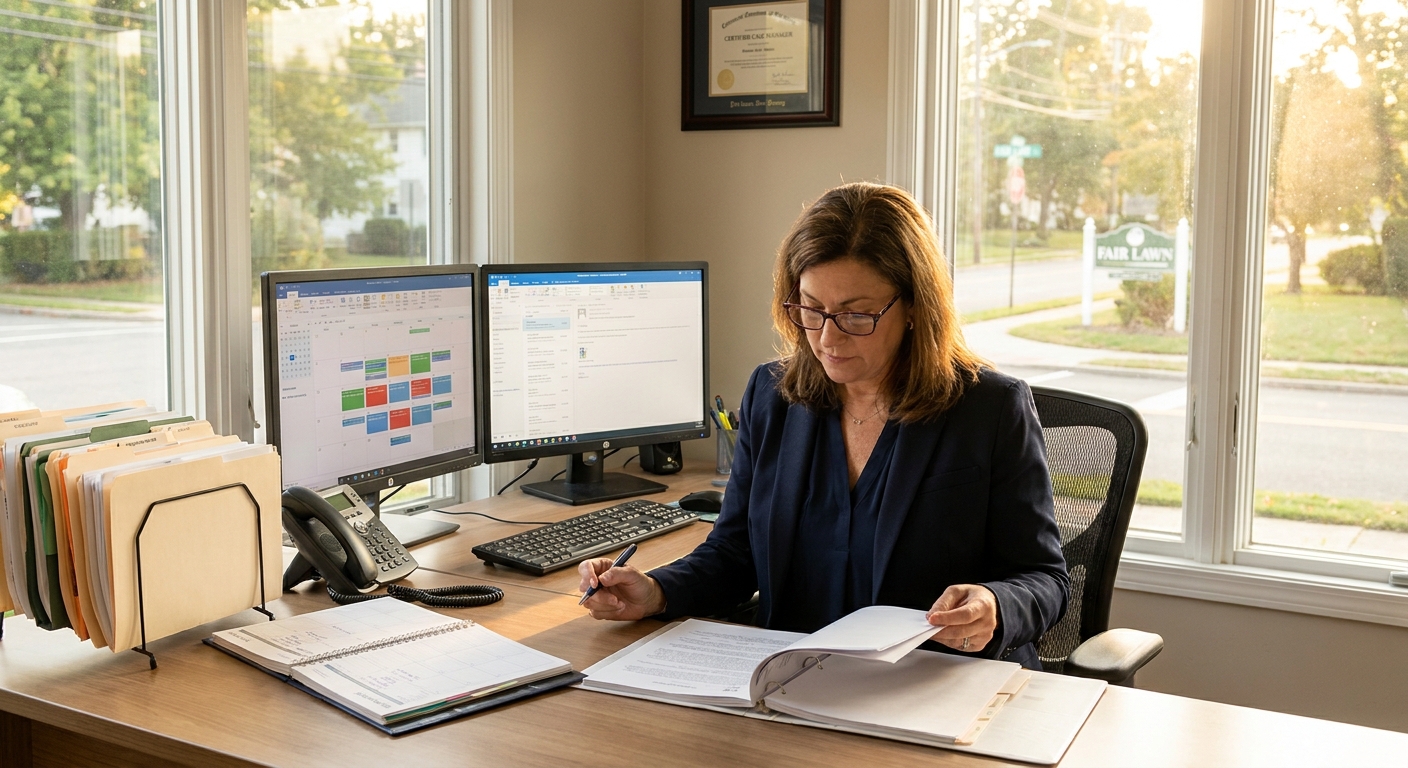
Your assigned case manager manages it, working alongside your primary therapist and clinical staff, and serving as the single point of contact for attorneys, probation and parole officers, Drug Court and Recovery Court personnel, and employer monitoring programs. You do not have to relay messages between your lawyer and your treatment team. The case manager does that.
Clinical oversight comes from Clinical Director Tammy Nussbaum, LCADC, CCS, a Licensed Clinical Alcohol and Drug Counselor with a Certified Clinical Supervisor credential. The team around her includes dual-licensed therapists holding LCADC, LAC, and LSW credentials, CADC and CCADC counselors, a Certified Case Manager (CCM), peer recovery specialists, a pastor, and a Medical Director who is an MD and psychiatrist. That range matters when your legal situation sits on top of a mental health condition, because the same people documenting your progress for the court are the people managing your care.
The documentation itself is specific and court-ready. Your case manager can provide attendance verification, compliance letters, treatment enrollment verification, progress summaries, drug screening results when authorized, appointment verification, and discharge summaries. Every one of those goes out only after you sign a written authorization, and only to the party you name. Behind the scenes, case managers keep steady communication with your therapist, your medical provider, and the wider multidisciplinary team, so your treatment schedule, court requirements, drug testing, transportation, and recovery goals get coordinated together instead of competing. Coordinated behavioral health support, rather than fragmented services, is the model reflected in federal behavioral health coordination guidance. That is another tool on your tool belt, and it is one you do not have to build yourself.
How Does Legal Coordination Recovery in Fair Lawn Work for Clients Facing Active Court Proceedings?
It works by scheduling your treatment around your court appearances and drug testing instead of forcing you to choose between the two. The center assists clients involved with Drug Court, Recovery Court, probation, parole, pretrial supervision, DUI and DWI requirements, Family Court, child welfare cases, employer monitoring, and licensing or professional monitoring programs.
Fair Lawn sits in Bergen County, which means your proceedings may run through Bergen County Superior Court, a Hackensack municipal court, or a neighboring municipal court for a DUI or DWI matter. Your case manager coordinates with those local courts and probation departments specifically, not a generic idea of “the system.” If your court date shifts, your IOP schedule shifts with it. If your probation officer needs an updated letter mid-treatment, it gets handled without you having to leave work to chase it down.
The scheduling design is what makes legal coordination recovery in Fair Lawn possible for a working adult who cannot afford to disappear for three months. Programming runs mornings from 9AM to 12PM and evenings from 6PM to 9PM, with telehealth available, so someone commuting home from a job in Paramus, Paterson, or New York City can still make group and still satisfy the court in the same week. One client kept working full time on buprenorphine, attended evening IOP, coordinated medication management with the psychiatric provider, received help meeting his probation requirements, and worked with case management on employment and housing goals, all without interrupting his job. Another client lost his driver’s license after a DUI and stayed employed anyway, attending evening IOP consistently, receiving medication management, and meeting probation requirements because transportation and scheduling were arranged through one care plan. Those are the real world stressors this service is built for.
What Can Your Attorney, Probation Officer, or Employer Actually Find Out?
Nothing reaches your attorney, probation officer, court, or employer without your written authorization. Federal confidentiality rules for substance use disorder records under 42 CFR Part 2, along with the HIPAA Privacy Rule, require your signature before any information is disclosed, and even then the disclosure is limited to the party you name and only to the extent necessary.
This is the fear that keeps a lot of people from picking up the phone: the belief that entering treatment means their business becomes everyone’s business. It does not. If your probation officer asks whether you are enrolled and attending, your case manager can confirm that after you authorize it, and the confirmation is exactly that, not a transcript of what you said in group. Your clinical details, your history, the content of your therapy sessions, none of that travels beyond what a specific legal requirement or court order actually demands.
That protection is enforced through required Releases of Information, which you review and sign, and which spell out who receives what. You can see the limits before anything goes out. If a court order requires a particular document, the case manager provides that document and nothing more. The point is not secrecy for its own sake. The point is that admitting you need help, and getting it, should never become a weapon used against your job, your license, or your custody. Seeking treatment is not proof you have failed. It is proof you decided to get back on your feet, and the confidentiality rules exist to protect that decision.
How Does Legal Coordination Fit Into the Rest of Your Care Plan?
Legal coordination is one thread inside a full care plan that also covers your psychiatric care, your medication, your job, your housing, and your transportation, all managed together. The Medical Director, an MD and psychiatrist, oversees psychiatric care and MAT coordination in-house, providing psychiatric evaluations and medication management, including non-narcotic medications, for co-occurring conditions. So if you are managing a mental health condition alongside a substance use disorder while also facing court, you receive coordinated psychiatric care and MAT coordination under the same roof instead of being sent to three separate providers who never speak to each other.
The employment piece is where this gets practical. Losing your job is often the real fear underneath everything, because if the job goes, the house and the family stability can follow. Your case manager can align you with FMLA paperwork, which the doctor reviews to follow protocol, and can complete temporary disability applications. In one case, a client’s FMLA paperwork went to HR granting 90 days off work, with temporary disability covering that same 90 days, so he could focus fully on treatment while his job stayed protected. That is coordination doing exactly what the Family and Medical Leave Act was written to allow, applied to your situation instead of left as a form you never understood.
Wraparound case management pulls the rest together: housing through a recovery-oriented living network, vocational and job placement support, transportation solutions, MAT coordination, and legal coordination, all under one plan. Treatment gets built around the life you are already holding together, not on top of its wreckage. We are here to support you every step of the way, and that means the whole life, not only the hours you spend in group.
What Does Legal Coordination Produce When It Actually Works?
It produces people who keep their jobs, satisfy their courts, and stay in recovery at the same time. The clearest example the team describes is a gentleman who had been in treatment 26 times. He arrived high acuity, needing housing, vocational support, and help with legal issues, carrying every reason to expect the twenty-seventh attempt to fail like the rest.
Today he has a job. His legal obligations are settled. He has stable living. And he recently celebrated 90 days. What changed was not willpower he suddenly located after 26 tries. What changed was that housing, employment, and legal coordination were handled together under one care plan, so the pieces that had collapsed every prior time were held in place long enough for recovery to take. Fragmented services had failed him repeatedly. Coordinated services gave him a different result.
No one can promise a specific outcome, and recovery is never guaranteed for anyone. What can be offered is a structure that stops treatment and court requirements from cannibalizing each other, so you get a fair chance to meet both. That structure is the difference between managing your competing demands and watching them collapse into missed appointments, a violated probation, and lost opportunities. Legal coordination recovery in Fair Lawn, tied to vocational and housing support under one plan, may produce what scattered, disconnected help cannot.
Call Resilience Recovery Center in Fair Lawn, NJ to speak with a case manager about coordinating your treatment schedule with your court dates, probation requirements, and work obligations under one care plan. Bring the deadline that is worrying you most, and let the person who does this every week start lining it up with the rest.
Frequently Asked Questions
Can my probation officer find out I’m in treatment without my permission?
No. Federal confidentiality rules under 42 CFR Part 2, together with the HIPAA Privacy Rule, require your written authorization before any information is disclosed to a probation officer, court, or attorney. Even with authorization, disclosure is limited to the party you name and only to the extent necessary, through a signed Release of Information.
How does legal coordination help if I have a DUI case and work full time?
Your case manager coordinates evening IOP from 6PM to 9PM, your court dates, your drug testing, and your compliance letters so you can meet legal requirements and treatment goals without missing work. One client who lost his license after a DUI stayed employed because transportation and scheduling were arranged through one care plan, attending evening IOP consistently while meeting his probation requirements.
What if I need treatment but can’t lose my job to attend?
The case management team can align you with FMLA paperwork, which the doctor reviews to follow protocol, and can complete temporary disability applications. In one case this granted a client 90 days off work with temporary disability for the same 90 days, so he could focus on treatment while his job stayed protected.
Does Resilience Recovery Center work with Drug Court or Recovery Court in Bergen County?
Yes. Case managers communicate directly with Drug Court and Recovery Court personnel, coordinate your schedule around court appearances and drug testing, and provide required documentation under written authorization, including attendance verification, compliance letters, and progress summaries.
Can the center help with a child welfare case or Family Court requirements?
Yes. When you authorize it, case managers provide documentation to Family Court and child welfare agencies and coordinate your treatment schedule around court appearances and parenting requirements, so your recovery and your family obligations are handled in the same plan.
What happens if my court date changes or my attorney needs a letter mid-treatment?
Your case manager serves as the single point of contact, provides compliance letters and other verification when authorized, and adjusts your IOP schedule to accommodate the new court date or legal obligation, so a shift in your legal calendar does not derail your treatment.