
According to SAMHSA’s 2022 National Survey on Drug Use and Health, more than 21 million adults in the United States live with both a substance use disorder and at least one mental health condition at the same time. If you are entering or considering structured outpatient treatment, understanding how co-occurring disorders affect treatment outcomes is not background knowledge , it is the single most important thing that determines whether your treatment plan will actually work.
What Co-Occurring Disorders Actually Are
A co-occurring disorder means two distinct conditions exist at the same time: a substance use disorder and at least one diagnosable mental health condition. The clinical term is dual diagnosis, and it applies whether the mental health condition is depression, anxiety, PTSD, ADHD, bipolar disorder, or something else entirely.
The distinction that matters most here is this: neither condition is simply a symptom of the other. Depression is not just what happens when you drink too much. Anxiety is not just withdrawal. Both are independent diagnoses, each with its own clinical profile, and both require direct, simultaneous treatment. When a program addresses only one, the untreated condition continues to function as an active obstacle to recovery.
SAMHSA’s 2022 data found that among adults who received substance use treatment, approximately 50 percent also met criteria for a mental health disorder. In real terms, that means dual diagnosis is not the exception in treatment settings , it is the norm. If you have struggled to maintain progress despite genuine effort and motivation, a co-occurring condition is one of the most common and most overlooked explanations.
Why Co-Occurring Disorders Are So Common
The high overlap between mental health conditions and substance use is not coincidental. Three mechanisms drive it consistently, and understanding them changes how you interpret your own history.
The first is self-medication. A 2020 National Epidemiologic Survey on Alcohol and Related Conditions (NESARC-III), conducted across a nationally representative sample of over 36,000 adults, found that individuals with mood or anxiety disorders were two to five times more likely to develop a substance use disorder than those without. The mechanism is straightforward: when anxiety, depression, or trauma symptoms go unrecognized or untreated, substances provide temporary relief. What starts as functional coping escalates into dependence.
The second mechanism is shared neurological vulnerability. Certain genetic and neurobiological profiles increase the risk of both mental illness and substance use disorder simultaneously. The brain systems involved in stress regulation, impulse control, and reward processing overlap significantly between the two. This is why psychiatric conditions and addiction tend to cluster in families, and why treating one without the other produces incomplete results.
The third mechanism is trauma. Adverse childhood experiences, chronic stress, and acute trauma are strongly associated with both PTSD and substance misuse. Trauma dysregulates the same neurological systems that underlie both conditions, which is why trauma-informed care has become a foundation of effective dual diagnosis treatment. The connection between emotional dysregulation and addiction runs directly through the trauma response.
For anyone entering intensive outpatient (IOP) or partial hospitalization (PHP) treatment, this prevalence data carries a practical message: if your history includes mental health symptoms, prior treatment attempts that didn’t hold, or difficulty managing emotions alongside substance use, the likelihood of a co-occurring condition is high enough to warrant formal screening before a treatment plan is finalized.
The Most Common Mental Health Conditions That Pair With Substance Use
Depression and Substance Use Disorder
Depression and alcohol use disorder are among the most frequently co-occurring pairs in clinical settings. A 2019 meta-analysis published in the journal Addiction, covering 140 studies and over 500,000 participants, found that individuals with major depressive disorder had a 40 percent higher risk of developing a substance use disorder compared to those without depression. In the reverse direction, heavy alcohol use significantly increases the risk of developing depressive episodes.
The mechanism involves both neurochemistry and behavior. Alcohol is a central nervous system depressant that temporarily blunts emotional pain, but it also disrupts serotonin and dopamine regulation, deepening depressive symptoms over time. The cycle is reinforcing: depression drives substance use, and substance use worsens depression. Understanding the connection between depression and alcohol use is often the starting point for understanding why someone’s recovery has stalled across multiple attempts.
In an outpatient setting, integrated screening for depression changes the entire clinical picture. When depression is identified and treated concurrently with substance use disorder, treatment retention improves measurably. Programs that screen for depression at intake and adjust the treatment plan accordingly consistently outperform those that treat substance use in isolation.
Anxiety Disorders and Substance Use Disorder
A 2017 study published in JAMA Psychiatry, drawing on data from over 43,000 adults in the NESARC-III survey, found that anxiety disorders were among the strongest independent predictors of substance use disorder. People with generalized anxiety disorder (GAD) were three times more likely to develop alcohol use disorder than those without anxiety. For panic disorder, the association was even stronger.
Untreated anxiety drives relapse because anxiety symptoms are persistent, physical, and difficult to tolerate without relief. Substances suppress the nervous system’s alarm response, which is why alcohol and benzodiazepines are so commonly misused by people managing chronic anxiety. The short-term relief is real, which is what makes the pattern so reinforcing and so difficult to interrupt without addressing the underlying anxiety directly.
Generalized anxiety and PTSD are both anxiety-spectrum conditions, but they respond to different treatment approaches. GAD typically responds well to cognitive behavioral therapy and certain pharmacological interventions. PTSD requires trauma-focused protocols, which are covered in more detail below. This distinction matters in treatment planning because applying a GAD treatment model to someone with complex PTSD consistently underperforms. If you use substances primarily to manage panic, social anxiety, or chronic worry, the pathway from anxiety to substance misuse is one of the most predictable and treatable patterns in dual diagnosis care.
ADHD and Substance Use Disorder
ADHD is one of the most under-diagnosed conditions in adult treatment populations, and its role as a driver of substance misuse is consistently underestimated. A 2015 meta-analysis published in the American Journal of Psychiatry, analyzing 83 studies covering over 140,000 individuals, found that adults with ADHD were three times more likely to develop a substance use disorder than adults without the diagnosis. Stimulant misuse and alcohol use disorder were the most common presentations.
ADHD is frequently missed in dual diagnosis assessments for a specific reason: its symptoms overlap with both active intoxication and withdrawal. Impulsivity, difficulty concentrating, emotional dysregulation, and poor follow-through all appear in ADHD, stimulant withdrawal, and alcohol dependence simultaneously. Without structured, validated ADHD screening, clinicians often attribute these symptoms to the substance use alone, and the ADHD goes untreated.
When ADHD is correctly identified, the treatment plan changes substantially. Unmedicated ADHD in a recovery setting means the client is attempting to engage with structured programming, group therapy, and behavioral change while their attentional system is significantly impaired. Addressing ADHD through appropriate pharmacological and behavioral support directly improves engagement with the recovery process. The research on ADHD as a driver of substance use disorder makes a strong case for systematic ADHD screening at intake in all dual diagnosis programs.
PTSD and Trauma-Related Disorders
The Department of Veterans Affairs has produced some of the most cited data on PTSD and substance use comorbidity. VA research consistently shows that among veterans with PTSD, approximately 30 to 60 percent also meet criteria for a substance use disorder, with alcohol being the most common substance. Civilian data from the 2013 National Comorbidity Survey Replication found similar patterns: adults with PTSD were 2 to 4 times more likely to develop a substance use disorder than those without a trauma history.
The mechanism is avoidance. PTSD produces intrusive memories, hypervigilance, and emotional numbing that are acutely distressing and difficult to regulate without external intervention. Substances provide a reliable, fast-acting suppression of these symptoms in the short term. The problem is that avoidance maintains PTSD rather than resolving it, and over time, the nervous system becomes dependent on the substance to manage a trauma response that has never been processed. Understanding how PTSD and addiction reinforce each other is central to understanding why treating substance use without trauma consistently produces worse outcomes across all long-term follow-up data.
Evidence-based trauma therapies, particularly Prolonged Exposure (PE) and Cognitive Processing Therapy (CPT), are specifically designed to interrupt this avoidance cycle. Integrated programs that combine trauma-focused therapy with substance use treatment show markedly better outcomes than sequential models, where PTSD treatment is deferred until sobriety is established.
How Co-Occurring Disorders Complicate Diagnosis
The most fundamental diagnostic challenge with dual diagnosis is that substances mask, mimic, and amplify psychiatric symptoms. Heavy alcohol use produces anxiety and depression. Stimulant use mimics mania. Opioid withdrawal produces symptoms that resemble panic disorder. When someone presents to treatment during active use or in early withdrawal, the clinical picture is almost always confounded.
A 2018 review published in Current Psychiatry Reports estimated that misdiagnosis or delayed diagnosis of co-occurring disorders occurs in a substantial proportion of treatment admissions, primarily because initial assessments are conducted too close to the last use. Psychiatric symptoms observed during acute intoxication or withdrawal frequently resolve or shift once the substance is removed, making it difficult to distinguish a primary mental health condition from substance-induced symptoms.
The “which came first” question is one of the most common concerns people raise before entering treatment, and it is also one of the least clinically useful. Research consistently shows that determining temporal primacy has minimal bearing on treatment design. What matters is identifying all active conditions at the time of assessment. The myth that treatment should wait until after the substance is out of the system causes harmful delays. Both conditions require simultaneous assessment and treatment from the start.
A proper dual diagnosis assessment is different from a standard intake in several concrete ways. It uses validated screening tools rather than clinical impression alone. It accounts for timing relative to last use, typically reassessing psychiatric symptoms at two to four weeks after acute withdrawal resolves. It collects collateral history from family or prior providers when available, and it distinguishes between symptoms that persist across periods of sobriety and those that resolve with abstinence. If the intake process you experience does not include these components, you are not receiving a complete dual diagnosis assessment.
The Direct Impact on Treatment Outcomes
Retention Rates Drop Without Integrated Treatment
A 2017 meta-analysis published in the Journal of Substance Abuse Treatment, covering 52 studies and more than 8,000 participants, found that individuals with co-occurring disorders enrolled in non-integrated programs had significantly higher dropout rates than those in integrated treatment. The dropout differential was approximately 25 to 30 percent across program types. In non-integrated settings, clients with untreated psychiatric conditions consistently leave earlier, and they leave before completing the clinical work that produces durable recovery.
What this means in practice: dropout is not primarily a motivation problem. When someone with unaddressed depression or anxiety leaves treatment early, it is often because the treatment plan does not address the conditions that make engagement difficult. Integrated care improves retention because it treats the conditions that drive avoidance and disengagement. Before enrolling in any structured outpatient program, ask directly whether psychiatric assessment and treatment are built into the clinical plan from day one, not added later as a referral.
Relapse Risk Increases When One Condition Goes Untreated
A 2020 longitudinal study published in Drug and Alcohol Dependence, following 1,200 adults through 12 months of outpatient treatment, found that untreated depression at treatment entry was associated with a 60 percent increase in relapse within the first 90 days. Untreated anxiety produced a comparable risk elevation. The mechanism is not complicated: an unmanaged mental health condition generates the same internal states that substances were used to relieve.
This is worth stating plainly. If your treatment plan addresses your substance use but does not include active psychiatric treatment for a co-occurring condition, the treatment plan contains a structural gap that directly predicts relapse. Understanding how untreated mental health drives relapse is not abstract clinical theory. It is a description of what happens biologically and behaviorally when one half of a dual diagnosis goes unaddressed.
To evaluate whether your current treatment plan covers both conditions, look for two things. First, is there a licensed clinician providing direct psychiatric care, not just a referral to an outside provider? Second, are your mental health symptoms reviewed and adjusted as part of treatment progress reviews, not only when you raise a concern? If the answer to either is no, that is the gap to address first.
Overdose Risk Is Higher in Dual Diagnosis Populations
NIDA data from 2021 indicates that individuals with co-occurring psychiatric disorders account for a disproportionate share of overdose fatalities. A specific analysis from the American Journal of Psychiatry (2019), examining over 400,000 substance use treatment admissions, found that clients with co-occurring mood disorders had an overdose mortality rate approximately twice that of clients with substance use disorder alone.
Three factors drive this elevated risk. First, untreated psychiatric symptoms impair judgment and reduce the effectiveness of harm reduction strategies. Second, some psychiatric medications interact with substances in ways that amplify respiratory depression or cardiovascular effects. Third, psychiatric crises, including acute depressive episodes and dissociative states linked to PTSD, significantly increase the likelihood of high-risk use behavior.
The conversation to have with your treatment provider is direct: if you have a co-occurring condition, what is the safety protocol during psychiatric destabilization? What is the plan if symptoms worsen before the medication reaches therapeutic levels? A program that treats both conditions needs a concrete answer to both questions, not a general reassurance.
Recovery Is Slower but More Durable When Treated Correctly
A 2019 study published in Psychiatric Services, following 600 adults through an integrated dual diagnosis program over 24 months, found that individuals in integrated treatment achieved lower relapse rates at the two-year mark than comparable clients treated for substance use disorder alone, despite a longer average time to reach sobriety milestones. The integrated group also showed significantly lower rates of psychiatric hospitalization and emergency department utilization.
The takeaway is that slower early progress in integrated treatment is not a failure signal. It reflects the reality that two conditions are being treated simultaneously, that symptoms fluctuate as psychiatric medications are adjusted, and that processing underlying trauma or mood disorder takes time that single-focus programs do not account for. If you are in integrated treatment and your progress feels slower than you expected, that is often the program working correctly, not a sign that treatment is failing.
What Integrated Treatment Looks Like in Practice
Integrated treatment is a specific clinical model, not just a marketing term. It means a single, coordinated treatment plan that addresses both substance use disorder and the co-occurring mental health condition at the same time, delivered by a unified clinical team. It is not two separate programs running in parallel. It is not a referral to a mental health provider outside the treatment setting. It is one plan, one team, simultaneous treatment.
SAMHSA’s Treatment Improvement Protocol (TIP) 42, the federal clinical guideline for dual diagnosis care, specifies that integrated treatment outperforms both sequential models (treat one, then the other) and parallel models (treat both, but separately) on virtually every outcome measure, including retention, relapse rates, psychiatric symptom severity, and long-term functional status.
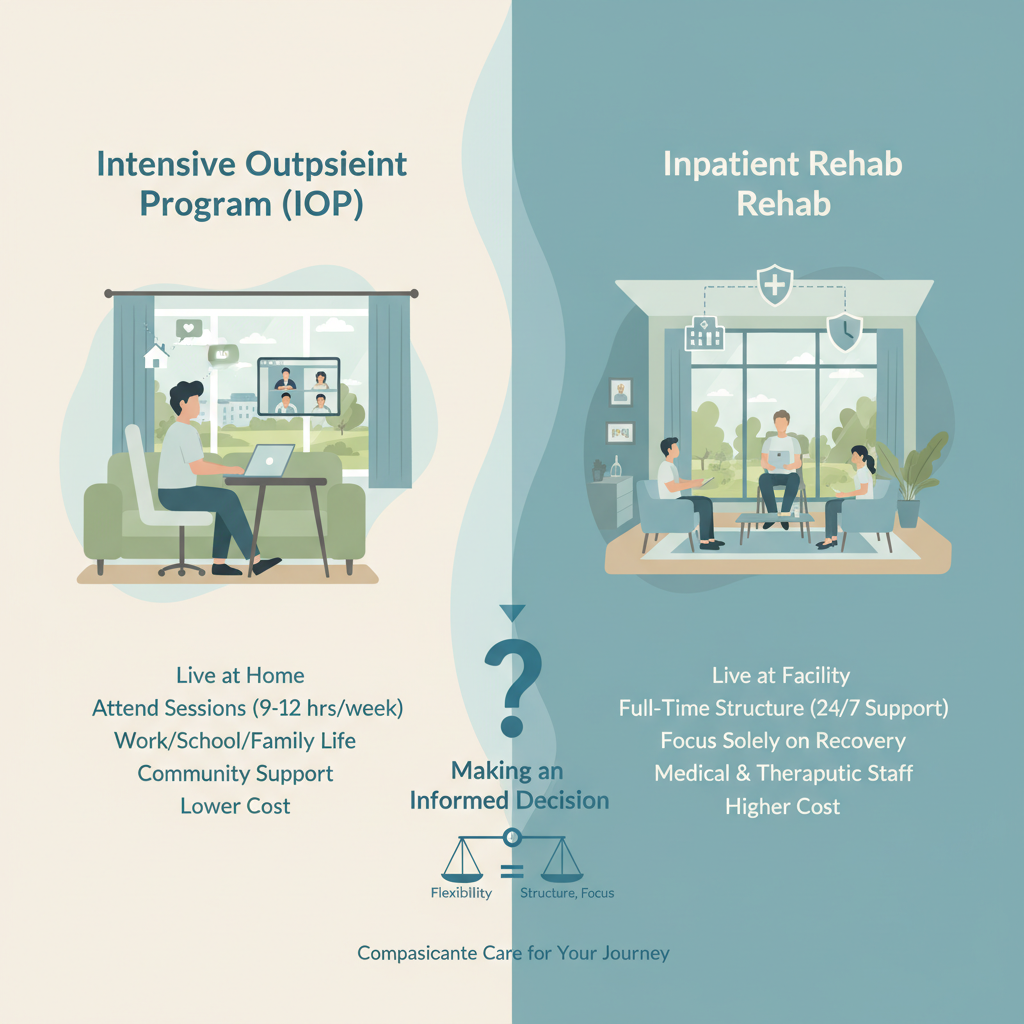
For working adults, parents, and those stepping down from higher levels of care, the relevant formats are intensive outpatient programs (IOP) and partial hospitalization programs (PHP). IOP typically involves nine to twelve hours of structured treatment per week, scheduled in morning or evening blocks to accommodate work and family obligations. PHP operates at a higher intensity, usually twenty to thirty hours per week, and functions as a bridge between inpatient or residential care and IOP. Both formats can deliver integrated dual diagnosis care when the clinical team includes psychiatric prescribers, licensed therapists trained in evidence-based modalities, and care coordinators who manage the full treatment plan. The difference between a dual diagnosis program and standard addiction treatment is precisely this level of coordination, and it is worth verifying before committing to a program.
Pharmacological Approaches
Medication-assisted treatment (MAT) in a dual diagnosis context is more complex than MAT for substance use alone, because psychiatric medications and MAT protocols interact. A 2021 study published in the Journal of Clinical Psychiatry, examining outcomes in 450 dual diagnosis clients on combined buprenorphine and antidepressant therapy, found that the combination was both safe and associated with significantly better depression outcomes than antidepressant therapy alone.
The practical issue is that not all prescribers are equally experienced with managing both sets of medications simultaneously. Some antidepressants affect the metabolism of buprenorphine. Certain mood stabilizers used for bipolar disorder require careful monitoring when combined with opioid agonist therapies. Benzodiazepines, frequently prescribed for anxiety, carry their own misuse risk in a substance use treatment context and require alternatives in most dual diagnosis plans.
The question to ask your prescriber is specific: how do the medications being used for my mental health condition interact with the medications being used for my substance use treatment? A prescriber experienced in dual diagnosis care will have a direct answer. One who defers the question to a separate provider is a signal that the care is not as integrated as the program describes.
Evidence-Based Psychosocial Treatments
The three primary evidence-based modalities for co-occurring disorders are Cognitive Behavioral Therapy (CBT), Dialectical Behavior Therapy (DBT), and trauma-focused therapies including Cognitive Processing Therapy (CPT) and Prolonged Exposure (PE). A 2018 meta-analysis in the Journal of Consulting and Clinical Psychology, covering 33 randomized controlled trials with over 5,000 participants, found that CBT-based approaches produced the most consistent improvements across both substance use and psychiatric outcomes in dual diagnosis populations, with DBT producing particularly strong results where emotional dysregulation was a primary feature.
DBT was originally developed for borderline personality disorder, but its skills-based approach to emotional regulation, distress tolerance, and interpersonal effectiveness maps directly onto the challenges dual diagnosis clients face. For anyone whose substance use is closely tied to managing overwhelming emotions, DBT provides a concrete skill set that addresses the function the substance was serving.
Group therapy in IOP settings works differently for dual diagnosis clients than for single-diagnosis clients. In a standard substance use group, the clinical focus is on recovery-specific content: triggers, cravings, relapse prevention, support networks. In an integrated dual diagnosis group, psychiatric symptoms, medication side effects, and the interaction between mood states and substance use become part of the group discussion. This changes the therapeutic dynamic substantially. Dual diagnosis groups provide validation that single-diagnosis peers cannot offer, and they normalize the complexity of managing two conditions simultaneously rather than implying that recovery should follow a simpler trajectory.
Barriers That Get in the Way of Accurate Dual Diagnosis Treatment
Three barriers account for the majority of failed or delayed dual diagnosis care. Identifying them is the first step to getting around them.
The first is stigma. Mental illness carries its own stigma separately from addiction, and carrying both labels is a significant deterrent to full disclosure at intake. A 2021 report from the National Alliance on Mental Illness (NAMI), based on surveys of over 3,000 adults in treatment, found that approximately 40 percent of respondents had withheld mental health history from a substance use treatment provider, most commonly because of concerns about being perceived as more difficult, being prescribed medications they did not want, or having their credibility questioned. Non-disclosure at intake directly prevents accurate assessment. The psychiatric history you share at intake is the information a clinical team uses to build your treatment plan. Incomplete disclosure produces an incomplete plan.
The second barrier is fragmented care systems. The historical division between mental health services and addiction treatment services in the United States means that many programs are licensed, staffed, and funded to treat one or the other, not both. A 2020 analysis by the Substance Abuse and Mental Health Services Administration found that fewer than half of substance use treatment facilities offered any on-site mental health services. For a working adult managing a full schedule, being told to seek psychiatric care from a separate provider at a separate location creates a practical barrier that many people do not overcome.
The third barrier is insurance coverage gaps. Mental health parity laws require that insurance coverage for mental health and substance use disorders be equivalent to coverage for other medical conditions, but enforcement is inconsistent. Prior authorization requirements, session limits, and higher cost-sharing for psychiatric services remain common in practice. For someone balancing treatment costs against work and family expenses, these gaps directly limit access to the integrated care that produces the best outcomes.
What this looks like for a working adult is concrete: you find a program, the intake process does not include a formal psychiatric assessment, your employer-sponsored insurance covers outpatient substance use treatment but requires a separate referral process for psychiatric care, and the logistics of managing both defeat you before you have completed the clinical work. Advocating for integrated assessment at intake means explicitly requesting a formal dual diagnosis screening during the admissions process, not accepting a referral to an outside mental health provider as an equivalent alternative.
What to Look for in a Treatment Program
Evaluating a structured outpatient program for co-occurring disorders requires asking specific questions, not evaluating general impressions. A 2016 study in Psychiatric Services, examining outcomes across 60 dual diagnosis programs, identified the program features most consistently associated with better outcomes: integrated psychiatric services on-site, evidence-based treatment modalities delivered by licensed clinicians, individualized treatment planning that accounts for both conditions, and systematic outcome monitoring that tracks psychiatric symptoms alongside substance use.
The questions that reveal whether a program actually delivers these features are direct. Ask whether there is a psychiatrist or psychiatric nurse practitioner on the clinical team who provides medication management within the program, not as a referral. Ask which validated assessment tools are used at intake to screen for co-occurring conditions. Ask how the treatment plan changes if a co-occurring condition is identified after admission. Ask what happens clinically if psychiatric symptoms worsen during treatment.
On scheduling, ask specifically whether evening or morning program blocks are available and whether telehealth is an option for individual therapy sessions during higher-obligation weeks. For someone stepping down from PHP to IOP, ask how the transition plan accounts for psychiatric stability, not only substance use benchmarks. A program that adjusts step-down timing based on psychiatric symptom stability rather than only days of sobriety completed is operating with a dual diagnosis model. One that steps clients down on a fixed timeline regardless of psychiatric status is not.
The warning signs that a mental health condition is making addiction worse are often visible before treatment begins. A program that asks about those signs at intake and builds them into the clinical plan is demonstrating integrated care in practice, not just in description.
What to Try This Week
If you are currently in or considering treatment, ask your treatment team for a formal dual diagnosis screening using a validated assessment tool. Two of the most widely used combinations are the MINI International Neuropsychiatric Interview (MINI) paired with the Alcohol Use Disorders Identification Test (AUDIT), and the Patient Health Questionnaire-9 (PHQ-9) for depression combined with the Generalized Anxiety Disorder-7 (GAD-7) scale. These tools are standardized, brief, and designed to produce a clinical picture that goes beyond the presenting substance use complaint.
This single step changes the entire trajectory of a treatment plan because it converts a vague sense that “something else is going on” into a documented clinical assessment that the treatment team is required to address. Without it, mental health conditions remain clinical impressions rather than diagnoses, and clinical impressions are easy to deprioritize under program pressure. A validated screening result is not. Make this request at your next clinical appointment, or at the admissions meeting if you are evaluating programs. It is the most direct action you can take to ensure that both conditions are treated from the start.
Frequently Asked Questions
Can you have a co-occurring disorder without knowing it?
Yes. Many people enter substance use treatment without knowing they carry a co-occurring mental health condition, because psychiatric symptoms are often attributed to the substance use itself. Depression, anxiety, and ADHD are particularly common diagnoses that go undetected until a formal assessment is conducted. Symptoms that persist after two to four weeks of abstinence are a strong signal that a co-occurring condition may be present and warrant formal screening.
How long does treatment take when both conditions are being addressed?
Integrated dual diagnosis treatment typically takes longer to reach stable recovery milestones than single-diagnosis substance use treatment, but the long-term outcomes are substantially better. Duration depends on the specific conditions, their severity, the history of prior treatment episodes, and how well the treatment plan is tailored to both diagnoses. For most people in IOP or PHP, integrated treatment runs three to six months or longer, with step-down care continuing beyond that. Progress in integrated treatment is measured by both substance use and psychiatric stability, not one or the other.
What if a mental health condition is identified after treatment has already started?
A well-designed integrated program adjusts the treatment plan when new information emerges. If a co-occurring condition is identified during treatment rather than at intake, the clinical team should update the diagnosis, introduce appropriate therapeutic modalities, and initiate or adjust medication management as indicated. This is one of the reasons ongoing psychiatric monitoring throughout treatment, rather than only at intake, is a feature of quality dual diagnosis programs.
Does medication-assisted treatment still work if you have a co-occurring mental health condition?
Yes. The evidence for MAT, including buprenorphine and naltrexone, supports its use in dual diagnosis populations. Some psychiatric medications interact with MAT protocols and require monitoring, but these interactions are manageable by a prescriber with dual diagnosis experience. The combination of MAT and psychiatric medication is often more effective than either alone. The key is ensuring that both are managed by a coordinated clinical team rather than separate providers who are not communicating.
Why do people with co-occurring disorders relapse more often?
Relapse in dual diagnosis populations is most often driven by untreated or undertreated psychiatric symptoms. When depression, anxiety, trauma responses, or ADHD symptoms are not adequately addressed in treatment, they generate the internal states that substances were originally used to manage. Without a clinical plan that directly addresses those states, the behavioral pull toward substance use remains active. This is why integrated treatment, which addresses both conditions simultaneously, produces consistently lower relapse rates than treatment focused on substance use alone.
Is it possible to fully recover with a co-occurring disorder?
Yes. Dual diagnosis does not mean permanent instability or inevitable relapse. The research on long-term outcomes in integrated dual diagnosis treatment consistently shows that people who complete coordinated, evidence-based care for both conditions achieve durable recovery at rates comparable to single-diagnosis populations. Recovery with a co-occurring condition requires a more complex initial treatment plan and ongoing management of the psychiatric condition, but it is neither unusual nor out of reach. The most consistent predictor of long-term success is receiving genuinely integrated care from the start.