
Does BCBS Cover Outpatient Rehab in Fair Lawn, NJ? BCBS Rehab Coverage in Fair Lawn, NJ, Costs, and Verification Explained
You have the Blue Cross Blue Shield card in your hand, but the question keeping you from calling is whether this specific plan will actually cover outpatient treatment at Resilience Recovery Center in Fair Lawn, NJ, and whether you will be hit with thousands in unexpected bills after treatment starts. That single uncertainty stops families every day. It is also the reason BCBS rehab coverage in Fair Lawn, NJ is worth understanding before your family member ever walks through the door, because the honest answer depends on your exact policy, and the admissions team can verify it for you at no cost before you commit to anything.
Does BCBS Rehab Coverage in Fair Lawn, NJ Apply to Outpatient Treatment at Resilience Recovery Center?
Yes, Blue Cross Blue Shield frequently covers outpatient and intensive outpatient treatment, but coverage is never a flat yes or no. It depends on your employer plan, your deductible, whether the center is in-network or out-of-network for your specific policy, and whether the plan requires prior authorization.
The reason there is no single answer is that “BCBS” is not one plan. It is dozens of employer-sponsored policies, each with different behavioral health benefits, different deductibles, and different rules about substance use treatment. Two neighbors in Fair Lawn can both carry a Blue Cross Blue Shield card and have completely different coverage for the same level of care. That is why the admissions team never guesses based on the logo on the card. From the first phone call, a team member completes a confidential pre-screening, gathers your demographic and insurance information, reviews the substance use and mental health history, and then performs complimentary benefits verification.
What that means for you is simple. Before your family member starts treatment, you learn whether the plan pays, what portion it pays, whether authorization is needed, and roughly what your out-of-pocket responsibility could look like. You are not asked to sign up and hope. You get the financial picture first, explained in plain language, so the decision to begin treatment is made with facts instead of fear. If the plan turns out to be out of network, the team explores every appropriate option with you and, where it fits, walks through private pay and financial assistance as well.
What the Benefits Verification Call Actually Checks Before You Commit
Benefits verification is a detailed, documented review of your exact policy that the admissions team completes with the insurer before admission, so you know what to expect financially. It goes far beyond confirming the card is valid.
When you provide a BCBS card, the team first verifies that the policy is active and confirms the member information, effective date, plan type, and which BCBS entity or behavioral health administrator is actually managing the benefits. Substance use and behavioral health benefits are checked specifically, because those often differ from the general medical benefits. The team confirms whether the center is in-network or out-of-network for that particular plan, and if it is out-of-network, whether the policy carries out-of-network behavioral health benefits at all. Then they pull the numbers that determine your cost: the deductible, how much of it has already been met, the coinsurance or copay after the deductible, and the out-of-pocket maximum along with how much has accumulated toward it.
From there, the team verifies benefits for the actual level of care being considered, whether that is intensive outpatient (IOP) or standard outpatient (OP), and confirms whether prior authorization, pre-certification, a referral, or a medical-necessity review is required. They also check visit or day limits, exclusions, whether individual therapy, psychiatric services, medication management, and toxicology are handled and billed separately, and whether there are any specific billing or provider requirements that could affect coverage. Every detail is documented: the representative or verification source, a reference number when available, the date and time of the call, and any limitations or disclaimers given. Admissions then explains the findings to you honestly, including what insurance quoted and what your estimated responsibility may be, while being clear that a verification of benefits is not a guarantee the insurer will ultimately pay a claim. This transparency is how the team supports you every step of the way, and federal parity protections require most plans to cover behavioral health comparably to medical care, a right New Jersey families can review through the state’s mental health resources ombudsman.
Why “Out of Network” Rarely Means “Not Covered”
Out-of-network does not mean no coverage. Many BCBS plans include out-of-network behavioral health benefits, and treatment can often proceed once the actual policy is verified rather than assumed.
Families make this mistake constantly. They see BCBS on the card, hear that the center is not participating with that particular plan, and stop cold, certain treatment is off the table. In one situation the admissions team handled, a family did exactly that. Instead of accepting the assumption, the team verified the actual policy and looked specifically at the behavioral health and substance use benefits: whether the plan carried out-of-network coverage, the deductible, the coinsurance, the authorization requirements, and which outpatient levels of care were included. What changed the entire conversation was discovering that the client did have out-of-network behavioral health benefits. Being out-of-network did not automatically mean they could not receive treatment with Resilience Recovery Center.
The team then explained what those benefits actually meant, what the potential financial responsibility could be, and what still needed to be confirmed with the insurer before services began. For you, the lesson is worth holding onto during an exhausting, frightening time: do not disqualify your family member from care based on a single word from someone who has not read your specific policy. There are many BCBS plans, and benefits can be completely different from one policy to the next. Verifying the individual plan is what turns a dead end back into a path forward.
What Outpatient Rehab Will Cost You With a BCBS Plan
Your out-of-pocket cost depends on four numbers: your deductible, your coinsurance or copay after the deductible is met, your out-of-pocket maximum, and whether prior authorization is approved. The admissions team pulls all four during verification and gives you an estimated range before treatment begins.
Here is how those numbers work together in practice. If your deductible has already been partially or fully met this year, your share of the cost drops accordingly. Once you reach your out-of-pocket maximum, the plan generally covers the remaining approved services in full for the plan year. Coinsurance means you pay a percentage of the allowed amount, while a copay is a fixed dollar figure per visit. The team pulls exactly where you stand on each of these and translates it into a realistic estimate of what IOP or outpatient treatment could cost you.
No responsible provider guarantees a final number, because the ultimate figure depends on how the insurer processes each claim. What the team does provide is the most accurate estimate possible from the verification call, backed by the documented reference number and representative name kept in your records. That documentation matters if a claim is ever questioned. You deserve to know the financial reality before a crisis decision, not after the bills arrive, and getting that estimate up front is part of removing one more barrier between your family member and help.
What Prior Authorization Is, and Whether Your Plan Requires It
Prior authorization is a review some BCBS plans require before they will cover IOP or outpatient treatment, confirming the care is medically necessary before it begins. During verification, the admissions team finds out whether your specific plan requires it.
If authorization or pre-certification is required, the clinical team handles the submission. They send the comprehensive biopsychosocial assessment, the ASAM Criteria level-of-care justification, and the individualized treatment plan to the BCBS reviewer. The admissions team then tracks the authorization status and communicates the approval, or any request for additional documentation, to you before the first session is scheduled. You are not left refreshing a portal or making calls you do not understand. The people who do this daily do it for you.
Prior authorization exists because payers want confirmation that the level of care matches the clinical need, a safeguard the Substance Abuse and Mental Health Services Administration describes as standard practice in structured outpatient care. That process can feel like one more obstacle when your family is already stretched thin, covering shifts, managing the household, and holding your breath. Handled well, though, it works in your favor: a properly documented authorization protects the coverage and reduces the risk of a claim being denied later. The goal is a softer landing into treatment, without a paperwork surprise waiting on the other side.
How the Clinical Team Proves Medical Necessity to a BCBS Reviewer
Medical necessity is established by the multidisciplinary treatment team using the ASAM Criteria and a comprehensive biopsychosocial assessment, then reconfirmed every 30 days through a formal clinical review. This is the documentation that justifies your family member’s level of care to a BCBS reviewer.
Level-of-care decisions are not casual. They are made by the multidisciplinary treatment team using the ASAM Criteria, the national standard for placing a person at the right intensity of treatment. Every 30 days, a formal review is completed using the ASAM dimensions along with treatment plan progress, session attendance, urine drug screen results, medication adherence, participation in individual and group therapy, relapse risk, and mental health symptoms. The team also uses validated screening tools such as the PHQ-9 for depression and the GAD-7 for anxiety, so progress is measured, not merely described.
For you, this rigor does two things at once. It gives your family member care built on evidence rather than guesswork, and it produces the exact records a payer needs to keep coverage in place. Individualized treatment plans, standardized outcome measures, and documented multidisciplinary reviews all feed directly into the medical-necessity justification a BCBS reviewer expects to see. When a plan asks why continued IOP or outpatient care is warranted, the answer is already documented in clinical terms the reviewer recognizes. Strong documentation is quiet protection for your coverage, and it is one more reason fragmented, therapy-only programs often struggle where an integrated center holds up.
What Licensing Makes This Center Credible to a BCBS Plan
Resilience Recovery Center is licensed by the New Jersey Department of Health (DOH) and approved by the New Jersey Division of Mental Health and Addiction Services (DMHAS) to provide outpatient and intensive outpatient substance use treatment, operating under NJ facility license number 2001007 at ASAM level 2.1. These are the state credentials BCBS plans expect from a reimbursable outpatient behavioral health provider.
Credentials matter to a payer because they signal that care meets recognized clinical standards. The program is led by Clinical Director Tammy Nussbaum, LCADC, CCS, who brings 20 years of experience. The wider team includes dual-licensed LCADC therapists, along with LAC, LSW, CADC, and CCADC clinicians, CPRS peer recovery specialists, a certified case manager (CCM), a certified nutritionist, and an MD/psychiatrist serving as medical director. That mix aligns with the credentialing standards BCBS plans apply when they review outpatient behavioral health providers.
In the interest of full transparency, the center is not yet CARF or Joint Commission accredited, though it is actively pursuing national accreditation. That candor matters when you are choosing care for someone you love. State licensure under license number 2001007 and DMHAS approval already meet the standards required for reimbursable outpatient treatment, and the accreditation work underway reflects a program raising its bar rather than resting on the minimum. You can confirm New Jersey facility licensure directly through the state, which is exactly the kind of verifiable fact a careful family, and a careful payer, should be able to check.
What Outpatient Care Looks Like at This Fair Lawn Center
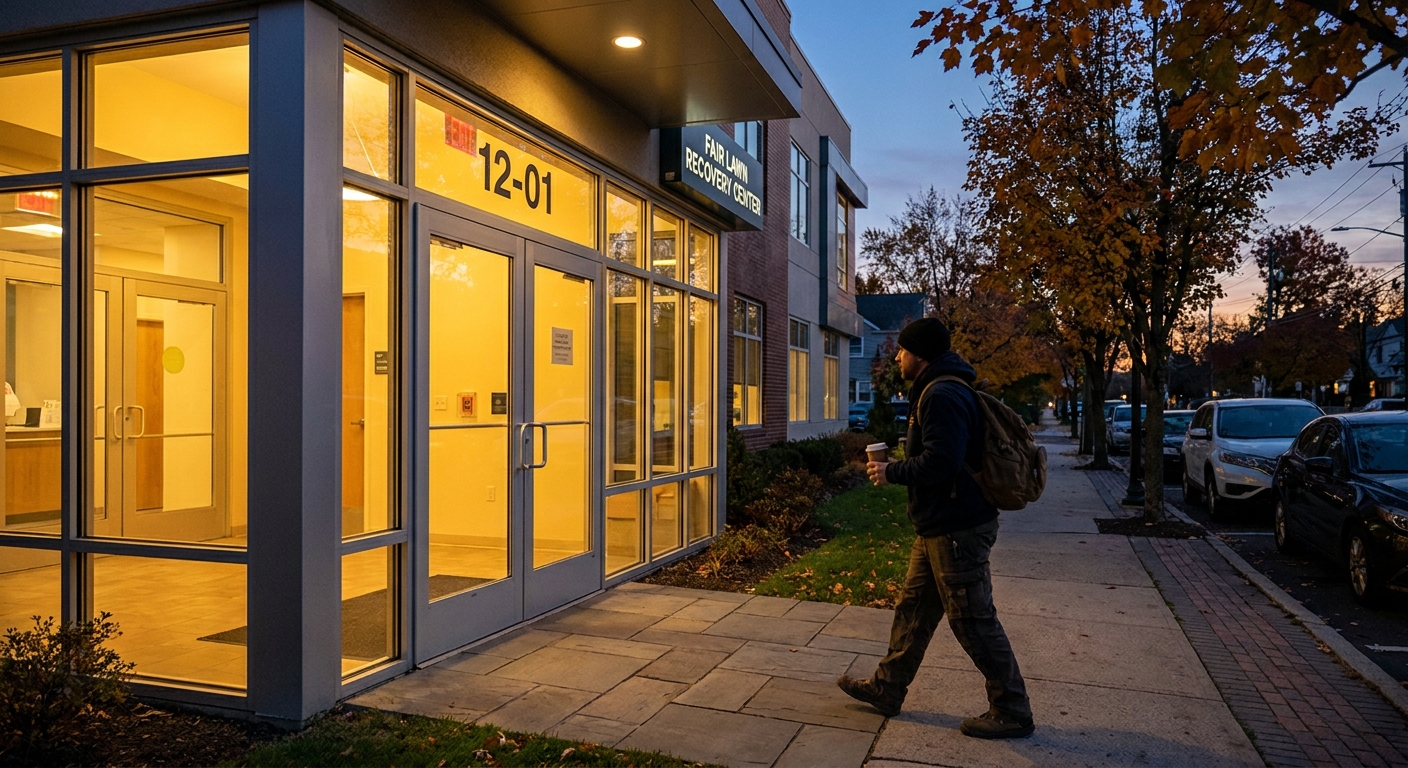
Resilience Recovery Center provides ASAM 2.1 outpatient and intensive outpatient substance use treatment in Fair Lawn, NJ, built so working adults can get help without stepping away from their jobs and families. The center serves the surrounding New Jersey community with real structure that fits real life, including a five-day-per-week IOP option for those who need more intensive support.
What sets this program apart from a therapy-only model is the wrap-around case management surrounding the clinical work. Alongside individual and group therapy and psychoeducation, the center coordinates medication-assisted treatment (MAT) with an accountability and education focus rather than prescribing, connects clients to a housing network with recovery-oriented living options, provides vocational and job placement support, offers legal coordination for those managing court obligations, and adds nutrition guidance, life coaching, relapse prevention planning, and transportation solutions. These are not extras. They address the real-world stressors that quietly derail recovery, and they strengthen the clinical documentation a payer reviews, because coordinated care produces a fuller, more defensible record of medical necessity.
For your family member, that integration means the tools on their tool belt are practical, not abstract. Someone can keep working while attending IOP, keep housing stable, keep a legal matter on track, and keep MAT aligned with the rest of their care, all through one coordinated team instead of a scattered set of appointments no one is connecting. This is treatment designed to get someone back on their feet without asking them to lose everything they have been holding together, and it is what BCBS rehab coverage in Fair Lawn, NJ is meant to make possible.
What to Do Next if You Have a BCBS Plan and Need Outpatient Rehab in Fair Lawn, NJ
The next step is a single phone call, and it costs you nothing but the time it takes. Call the admissions team at Resilience Recovery Center in Fair Lawn, NJ, provide your Blue Cross Blue Shield member ID and plan information, and request complimentary benefits verification.
From that first call, the team completes a confidential pre-screening and verifies your exact benefits: in-network or out-of-network status, deductible and out-of-pocket details, prior authorization requirements, and your estimated cost. They document the representative or verification source, the reference number when available, the date and time of verification, and any limitations or disclaimers given, then explain everything in plain language so you can make an informed decision before treatment begins. Here is the specific thing worth remembering: because BCBS rehab coverage in Fair Lawn, NJ varies so widely from one policy to the next, the only way to know your real numbers is to have someone read your exact plan, and that reading is free. You do not have to keep carrying this alone, and you do not have to guess about coverage while someone you love keeps slipping. Make the call, get the numbers, and let the team handle the verification from there.
Individual experiences and coverage outcomes vary by plan; verification of benefits is not a guarantee of payment.